
Micron Technology
-
What we have been saying for the past year....happy days
SK Group Chairman Chey Tae-won: “Chip supply shortages will persist through 2030… a price stabilisation plan will be announced soon.”
SK Group Chairman Chey Tae-won said the global memory chip shortage is likely to persist for another four to five years, lasting through 2030.
-
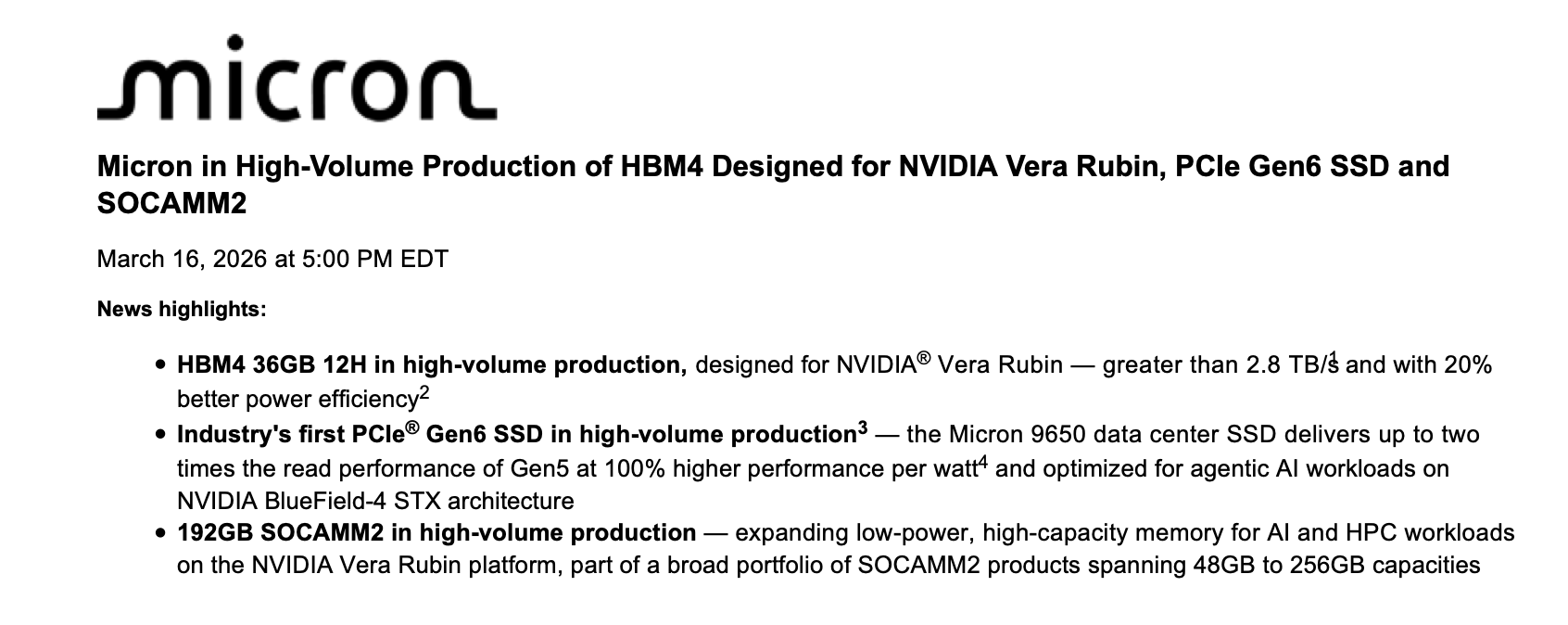
here is the proof-from Microns investor relations portal....
-
Earnings tonight-and they will be spectacular. However the reaction is a function of Options strategy
Micron is a textbook example of how options flow and dealer hedging can dominate short-term price action.
Before earnings, traders aggressively buy call options to bet on upside. Dealers who sell those calls hedge by buying stock (delta hedging), which creates real upward pressure (observed!). As the stock rises, the options’ delta increases, forcing dealers to buy even more shares (gamma effect). This feedback loop is why MU often rallies sharply into earnings.
By the time earnings arrive, positioning is crowded and dealers are heavily long stock as a hedge. The key shift happens after the event: implied volatility collapses, call options lose value, and traders either close positions or let them decay.
Dealers no longer need their hedge.
So they start selling the stock they previously bought.
That creates mechanical selling pressure — regardless of how good the earnings actually are. This is why MU can drop even after strong results: the “hedging bid” disappears.
In short, MU’s volatility isn’t just fundamentals — it’s driven by options positioning. Heavy call buying pushes it up pre-earnings, and the unwind of those hedges often pulls it down after.All I care about is the result and the guide (not whether the stock gains or loses 10%)-we will see if they get anywhere close to $11-$12 EPS on $23B and guide $27B and $15. Whatever the guide is it will be low-balled.
NB-the stock entered 2026 at $285 and in PM today it is $475! It was also below $400 only 6 days ago-no one knows what the reaction will be and it is irrelevant because the environment and Microns elite position within it can only mean continued record results as far as they have visibility. It would be nice if management mention contracts locking in 2027 supply-possible.
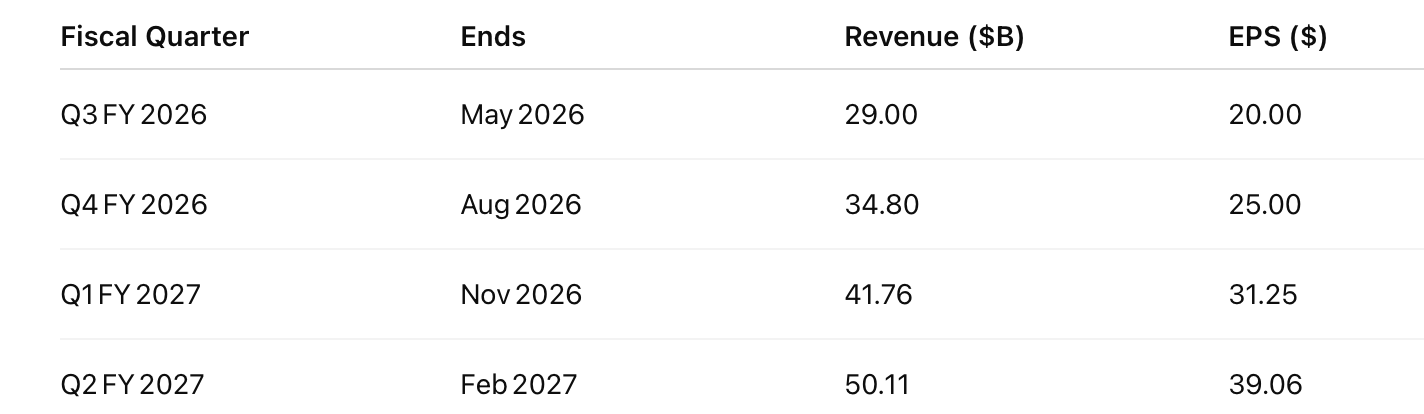
Imo the company will earn close to $100 over the next 12 months starting next Q and given we paid just under $90 13 months ago it just goes to show you how the market can misprice some assets. I think the actual results for the next year will look something like this:
-
What we want to see tonight is EPS > $10.50. Too hard to say what they will report beyond that. Potential for over $11.
Revenue > $22B
Guide-id be happy with anything +4B over the Q2 actual and an EPS +$3.50 over the Q2 actual. say circa $26B/$14...Their Guide was $18.7B and $8.40 EPS so the above would be a colossal beat.
-
Results are in. 24b and $12 eps. The guide is $33.5b and $19. No other way to describe it but.

-
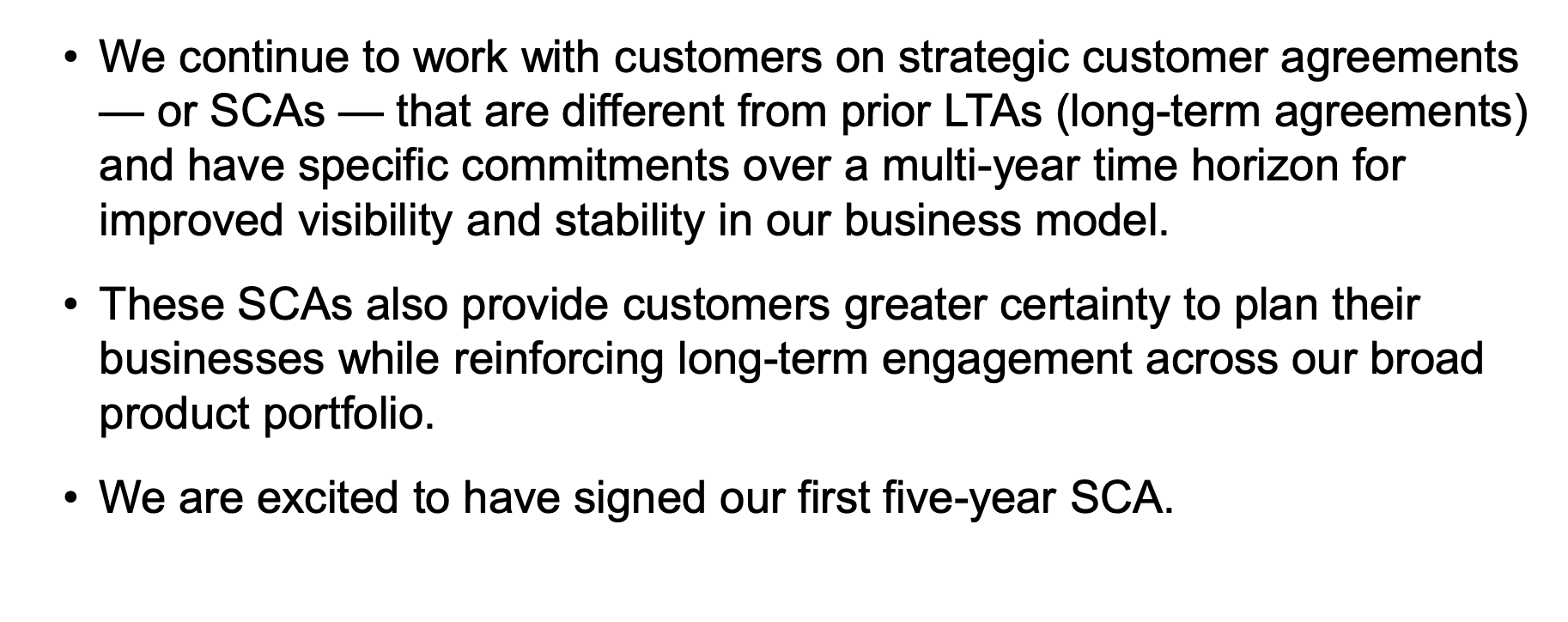
All you have to know really-from prepared remarks .For context, this isn't a 'we are sold out for 2026'. The SCA is a 5 year supply contract. Micron won't say but it points to Nvidia with 'many other SCAs are in progress'. I would speculate that pretty soon it's al going to be sold out for years.
The language used is intentional. One can interpret 'foreseeable future' however they choose depending on bias. My interpretation is 'years'. The fact remains all planned greeenfield sites globally, across all manufacturers will see bit growth in the 25-30% range whilst demand is 100% greater at least on the same annual basis. And this does not take into account level 3 and level 4 autonomous vehicles nor robotics which are coming and will need significant memory (edge devices).
Broadly speaking-if we are in a constrained environment we can expect ASP to continue to move up in the 50% range annually and coupled with bit growth of 20-25% and better yield (lower cost), the result is 70-80% revenue growth, margin growth and operating leverage continuing for the foreseeable future.
Of course if you don't believe spending on data centres will continue, we've peaked.


-
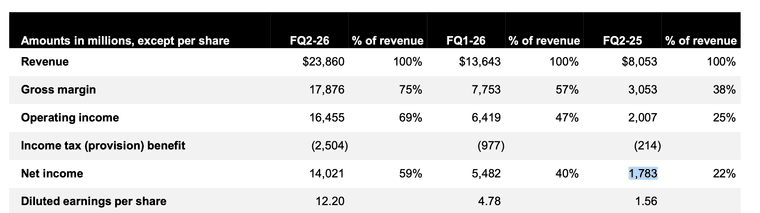
686% growth in net income
195% increase in RevenueFwd PE is around 4!
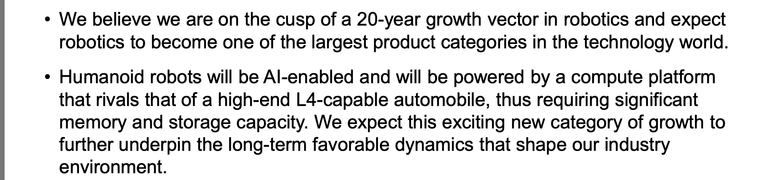
I agree that Data centre(racks) may not be the biggest long term driver. Edge cases are likely to be larger opportunities
-
Hi Al,
The same market priced the stock at $90 a year ago so it's really all you need to know about how efficient it is at times. The current situation is, and not too dissimilar to nvidia, they think it's peaked and the party is over. I think they are wrong and not slightly wrong either. The SCA 'with a very large customer' is an industry first and changes the landscape by giving certainty to Micron that a customer is contractually locked-in to buy large quantities for 'years'(5 in this case). That is not a trivial development. And let's face it, others will now get worried and also lock in long term deals or face exclusion.Remember two weeks ago when Jensen said 'we have secured our supply chain'

I am highly confident we won't stay at these levels for long. Analysts will certainly update their models this week as well.
The deal would look something like this:
Core Deal Structure
Size & Term: ~$100 -$130 billion over 5 years, covering HBM4e, HBM3e, and potential HBM5 supply for NVIDIA’s Vera Rubin AI and future GPU platforms.
Payment & Guarantees: NVIDIA commits to minimum annual purchase volumes (~$25 billion/year). Payments include base contract pricing plus potential escalators tied to wafer costs or memory market spot-rate increases. Shortfalls in volume may trigger penalties or make-good clauses to protect Micron.
Benefits:
For NVIDIA: Secures long-term HBM supply at hyperscale, ensures priority access, and hedges against extreme spot-market volatility.
For Micron: Guarantees $130 billion revenue over five years, improves production planning, and shares some market risk with a major customer.
Flexibility & Technology Alignment: Volumes and HBM generations may adjust over the contract to match AI demand growth, with co-optimisation of HBM designs for NVIDIA GPUs. -
Hi Al,
The same market priced the stock at $90 a year ago so it's really all you need to know about how efficient it is at times. The current situation is, and not too dissimilar to nvidia, they think it's peaked and the party is over. I think they are wrong and not slightly wrong either. The SCA 'with a very large customer' is an industry first and changes the landscape by giving certainty to Micron that a customer is contractually locked-in to buy large quantities for 'years'(5 in this case). That is not a trivial development. And let's face it, others will now get worried and also lock in long term deals or face exclusion.Remember two weeks ago when Jensen said 'we have secured our supply chain'
I am highly confident we won't stay at these levels for long. Analysts will certainly update their models this week as well.
The deal would look something like this:
Core Deal Structure
Size & Term: ~$100 -$130 billion over 5 years, covering HBM4e, HBM3e, and potential HBM5 supply for NVIDIA’s Vera Rubin AI and future GPU platforms.
Payment & Guarantees: NVIDIA commits to minimum annual purchase volumes (~$25 billion/year). Payments include base contract pricing plus potential escalators tied to wafer costs or memory market spot-rate increases. Shortfalls in volume may trigger penalties or make-good clauses to protect Micron.
Benefits:
For NVIDIA: Secures long-term HBM supply at hyperscale, ensures priority access, and hedges against extreme spot-market volatility.
For Micron: Guarantees $130 billion revenue over five years, improves production planning, and shares some market risk with a major customer.
Flexibility & Technology Alignment: Volumes and HBM generations may adjust over the contract to match AI demand growth, with co-optimisation of HBM designs for NVIDIA GPUs. -
It was a Trig moment, calling Rodders 'AL'
-
Dan Ives(analyst) said today...The increasing demand and tight supply of memory for artificial intelligence infrastructure buildouts will prompt prices of some memory types to surge by more than 100%, according to Wedbush.
"Not surprisingly, pricing for memory continues to lift aggressively, with DRAM and NAND likely to see 1H (means first half 2026) pricing increases well into the triple digits from CQ4'25 levels, with gains for the former likely approaching 130% - 150% and the latter nearly as robust," said Wedbush analysts in a Monday investor report.
This should bode well for memory makers such as Micron Technology (MU), Seagate Technology (STX), and Western Digital (WDC).
"No one should be surprised by an improvement in memory," Wedbush said. "However, the magnitude of the spike highlights how much markets have continued to improve as Q1 has progressed and certainly fits our recent positive checks around memory and MU's robust results and guidance."
"And we believe, given both this backdrop as well as further shortfalls in supply vs. demand, that HDD vendors are looking to price their future contracts more aggressively than they have previously suggested," Wedbush noted.
-
The next 4 quarters look something like
$20
$25 range
$30 range
$35 rangeSafe to say that our speculated $100 TTM EPS is highly likely. NB analysts until 4 weeks ago pegged their Nrs at $56 at the high end and sub $40 at the low end. It is not just ASP driving the growth but obviously it helps significantly. Bit growth is around 25% annualised and this is all the industry can produce until at least 2028. The demand/supply imbalance will persist for years imo given 2 quarters ago Demand over supply was circa 60% and today it is closer to 80%-the gap is widening and that is why prices are rising.
Today MU 1 yr Fwd PE is 4 with a growth rate exceeding 100% (closer to 200%) and conservatively a 5 yr CAGR of 65%.
What I find very interesting is planned Capex in calendar 26, confirmed last Q was an aggressive $25B and today they've upped this to $35B and more next year-it's clear to me they see something the market is ignoring. And what it might see as a negative (Capex) I see as a positive.
The biggest miss imo is as the data centre goggles up all this memory we have nascent markets building momentum. The edge is where the real fun begins. Robotics and mobile devices(Robots and cars)-everthing that moves will proliferate once the 'AIs' are at stage where their use becomes ubiquitous-and it will within the next 1-2 years.
-
By 2030, edge AI is projected to dominate total memory demand, far surpassing datacenter use. Even with conservative assumptions, billions of devices running sophisticated AI locally could consume 5–7 EB(exobyytes) of high-bandwidth memory (5–7 million TB), compared with roughly 1 EB in datacenter. Autonomous vehicles alone (not just cars, drones robots, tablets, phones)—potentially 100 million units worldwide—could carry 32–48 GB HBM-equivalent per car, while industrial and service robots, numbering perhaps 50 million, might each need 24–32 GB.
Consumer devices like AR/VR headsets, tablets, and smart home devices add billions more, though individual HBM demand is smaller, collectively accounting for several exabytes.
Annual additions will be substantial: roughly 10–20 million cars and 5–10 million robots per year, each increment consuming hundreds of petabytes of high-speed memory. Even with edge memory adoption tempered by cheaper stacked DRAM and LPDDR alternatives, the rate of growth is staggering, exceeding the production scaling plans of current HBM fabs. I would use the term 'forever constrained'The wedge of demand is steep: memory requirements increase not just linearly with new devices but also with the growing sophistication of AI models, which push per-device memory higher. As a result, planned memory fabrication capacity is unlikely to keep up, creating a structural bottleneck for ubiquitous, high-performance edge AI. Which, if correct would drive prices up for years as demand continues to exceed supply.
This is my take. Whilst today the market worries about the memory party to be over soon and im thinking even MUs planned $200B expansion plans will not be enough. This plan covers 10 years. I will speculate now that by the end of next year this 200B plan becomes $400B or more.
-
Micron Technology’s decision today to repurchase up to $5.4B of its senior notes is a clear positive signal about its financial strength and discipline. Using cash rather than issuing stock shows the company is generating solid cash flow and prioritising long-term balance sheet health over short-term optics.
By reducing higher-interest debt in the 5–6% range, Micron effectively locks in a risk-free return and lowers future interest expenses, which will support margins over time.
-
Just seen a report re Google developing chips that need less memory ..
The report indicated that this was behind the drops in Micron this week -
Hi C,
It's an algorithm not a chip and it's a nothing-burger. It has no impact on memory requirements whatsoever and it shows you just how ignorant the participants in the market are.
Google’s “Turbo” narrative is intellectually lazy. The leap from “better AI efficiency” to “less memory demand” ignores how technology adoption actually works. Efficiency lowers costs, which expands usage—basic economics. Dumping Micron Technology on that headline assumes AI growth is fragile and linear, when it’s explosive and compounding. It’s a textbook case of headline-chasing algos and shallow thinking masquerading as insight. No serious analysis, no nuance—just reflexive selling. If this is the market’s level of reasoning, it’s not pricing risk; it’s broadcasting confusion.
And if you want to get technical....
First, the “post rack-scale GPU” reality: once you’re deploying clusters at that level, memory bandwidth and capacity (HBM, interconnect efficiency, etc.) are hard constraints, not optional luxuries.
Software improvements don’t remove that—they just let you push the hardware harder. That typically increases utilisation, not reduces demand.
Second, the token growth point is the killer. If total tokens processed have exploded ~2500×, then a 6× efficiency gain is statistical noise. You’re still looking at orders-of-magnitude net growth in compute and memory demand. The denominator is moving way faster than the numerator.
Third, these optimisations aren’t new. Google and others have been shipping incremental efficiency gains for years—compiler improvements, sparsity tricks, better routing, quantisation, etc. The so-called “Turbo” angle isn’t some step-function event; it’s part of a continuous curve.
So the sell-off in Micron Technology assumes:
efficiency gains suddenly matter more than demand growth
and that this time is different from every prior cycle
That’s a weak assumption. In practice, efficiency gains + exploding demand = more total infrastructure, not less.Micron is so worried it's just about to buy another plant and repurpose it( 4 million sq feet) to accelerate its roadmap. And customers are signing 5 year supply agreements, scrambling to secure their supply chain, including Google who is a major customer. Rather than listen to the FUD look at the evidence. The company can only supply 50% of orders and > 80% margins and that imbalance is getting worse. It also completely ignores the edge device market which will be orders of magnitude bigger than data centre.
It's like the Deep-Seek moment we dont need these GPUs...oh wait.

