
Nvidia News
-
Worth a watch if you have X. https://x.com/elonmusk/status/2056179413901877551?s=20
And for context, Citadel is one of the world’s largest and most influential financial firms. Its hedge fund business manages more than US$60 billion in assets under management, making it among the biggest alternative investment managers globally.
-
Nvidia report tonight. My call:
$80B+ and $45B net income which equates circa $1.80 EPS. I think the guide will be close to $90B for next quarter(May through July).
We will receive updates on Rubin/Vera Rubin
-
Those are normal operational numbers. Non gaap including exceptional etc was 58b. There was a $15b revaluation (upwards) which would be related to one of their investments-listed I would think, prob Coreweave.
Operating cashflow +$50B
-
NVIDIA just delivered numbers that barely seem real. Revenue hit roughly $81.6b for the quarter, up 85% year-on-year, with data centre revenue alone at $75.2bn. Guidance for next quarter came in at around $91bn — comfortably ahead of expectations. Gross margins are still sitting around 75%, which at this scale is almost absurd.
This is arguably the most staggering earnings print corporate America has ever seen in absolute dollar creation. The key point is not just the growth rate — it is the combination of hypergrowth and elite profitability.
Most companies can do one or the other. NVIDIA is doing both simultaneously at a scale previously associated with oil majors or sovereign economies.
The market was worried margins would crack as Blackwell ramps and competition intensifies. Instead, management effectively said margins around the mid-70s are sustainable even while revenue accelerates towards a $350b+ annualised run rate. That changes the entire valuation debate.
Jensen Huang’s framing was telling: this is no longer about selling chips; it is about building “AI factories” and becoming the infrastructure layer for the next computing era. Hyperscalers are still spending aggressively, inference demand is exploding, and sovereign AI buildouts are only starting.
At this point the bear case is no longer “AI demand collapses”. The only credible concerns are geopolitical restrictions, customer concentration, or eventually the law of large numbers. But right now, the numbers keep overwhelming every attempt to call the peak.Management approved an additional $80b share buy back, which now totally $140b. The dividend was also raised 2,400% to 25c
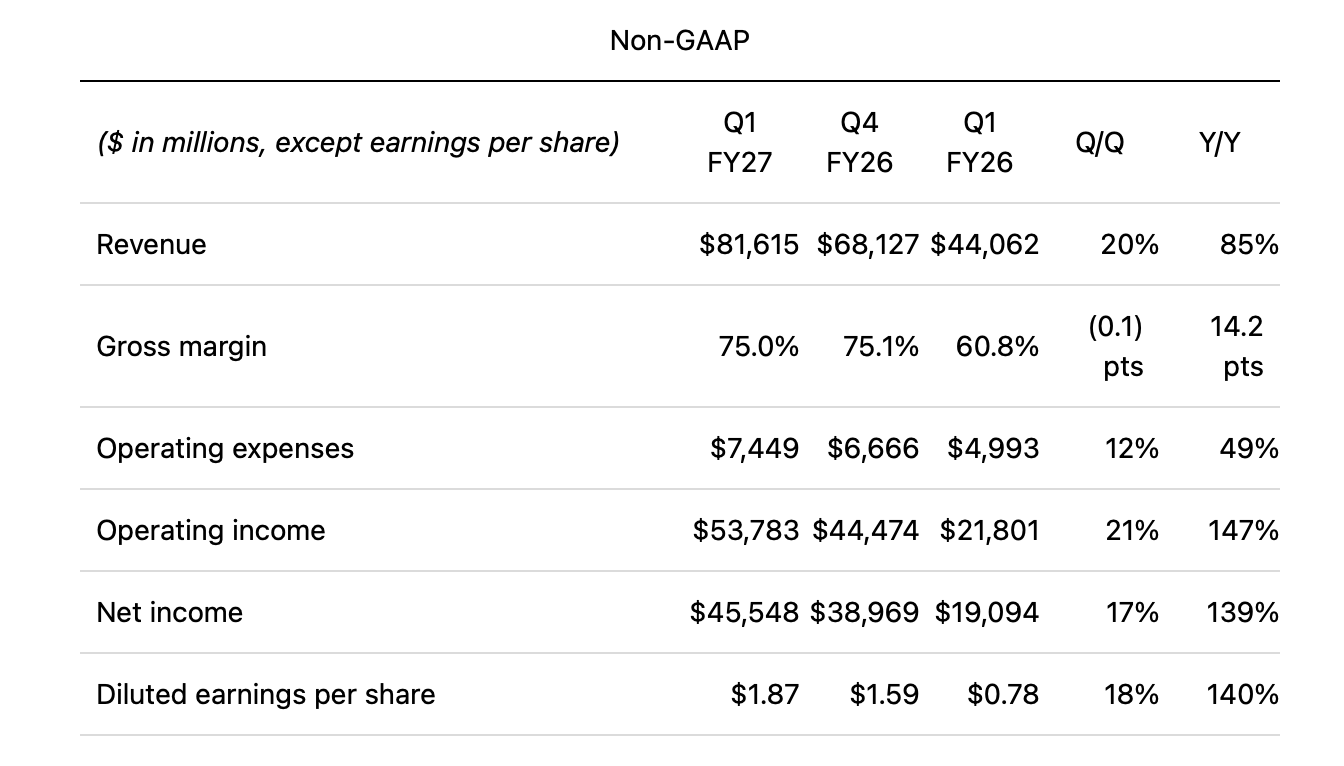
NB-Look at the growth. 85% on revenue and 140% on EPS. Massive operating leverage too. JA sub 20 Fwd PE. Perhaps 18.
Earnings call highlights:
Main Takeaways From NVIDIA Earnings
Revenue growth was massive — again
NVIDIA posted another record quarter:
Revenue reached $82B, up 85% year-over-year and 20% sequentially
This was the company’s 14th consecutive quarter of sequential growth
Free cash flow came in at $49B
Data Centre revenue alone was $75B
Management said demand for AI infrastructure continues to accelerate globally.
Blackwell demand is exploding
The dominant theme of the call:
Demand for Blackwell systems has gone effectively vertical.
Management stated:
Blackwell is the fastest product ramp in company history
Hyperscalers and frontier model companies are deploying hundreds of thousands of GPUs
GB300 demand is exceptionally strong
Blackwell now powers or supports nearly every major frontier AI lab
They repeatedly stressed that inference demand — not only training — is now driving enormous spending.
NVIDIA says “AI factories” are the new data centres
A major change in positioning:
NVIDIA no longer frames GPUs as standalone chips.Instead:
Customers are building “AI factories”
The important metric is no longer GPU purchase price
It is:
token throughput
token cost
utilisation
energy efficiency
lifetime economics
Jensen Huang essentially argued that compute capacity is now directly linked to revenue generation.
Their thesis:More compute = more AI output = more customer revenue.
They believe AI infrastructure becomes a multi-trillion-dollar market
One of the boldest claims:
Hyperscaler CapEx could exceed $1T annually by 2027
Total AI infrastructure spending could reach $3T–$4T per year by the end of the decade
Management believes AI is shifting from optional software enhancement to essential infrastructure across nearly every industry.
NVIDIA is changing how it reports the business
The company reorganised reporting into:- Hyperscale
Public cloud giants and major consumer internet firms. - ACIE
(AI cloud, industrial, enterprise)
This includes:
sovereign AI projects
AI-native clouds
enterprise deployments
industrial AI systems
Management strongly implied this second category could eventually surpass hyperscalers in size.
Jensen’s central argument: NVIDIA wins because it owns the whole stack
Huang spent a large portion of the call reinforcing this point.
NVIDIA claims its advantage is not merely GPUs, but:chips
networking
software
CUDA ecosystem
system integration
rack-scale infrastructure
deployment tooling
He described NVIDIA as the only company delivering a fully integrated AI platform across hyperscale, enterprise, sovereign AI, robotics, and edge computing.
Vera CPU was a major surprise
Possibly the most underappreciated part of the call.
NVIDIA now believes CPUs become critical in agentic AI systems.Why?
Because:
agents orchestrate tasks on CPUs
tools, browsers, memory systems, and workflows run on CPUs
GPUs still perform the “thinking”, but CPUs coordinate everything
They introduced:
Vera CPU
A custom ARM-based CPU tightly integrated with Rubin GPUs.
Claims included:1.5x faster per core
2x performance per watt
4x rack density versus x86 alternatives
Most striking statement:
NVIDIA sees nearly $20B in standalone CPU revenue this year.
That represents a substantial expansion beyond GPUs.
Rubin is arriving quickly
Rubin shipments begin in Q3.NVIDIA says Rubin could deliver:
up to 35x higher inference throughput
up to 10x greater AI factory revenue versus Blackwell
Huang also claimed:
every major frontier AI lab is expected to adopt Rubin
Rubin adoption could exceed Blackwell adoption
Inference is now the centre of the AI race
Another major shift in messaging.
The company repeatedly stated:AI has evolved from:
one-shot inference
→ reasoning
→ agentic AI
They now view inference as the dominant long-term compute market.
Jensen specifically said NVIDIA is rapidly gaining inference market share.Physical AI and robotics are becoming meaningful businesses
Edge computing revenue reached $6.4B.
They highlighted:robotics
autonomous vehicles
AI-powered telecoms networks
industrial systems
robotaxis
The company said physical AI generated more than $9B in revenue over the last 12 months.
China remains largely absent
Important detail:
NVIDIA said it is not including China data centre revenue in guidance because export restrictions remain uncertain.So current forecasts exclude potential China upside.
Capital returns increased sharply
NVIDIA announced:
dividend increase from $0.01 to $0.25
new $80B buyback authorisation
target to return roughly 50% of free cash flow to shareholders
That is a major signal of confidence.
Guidance exceeded expectations
Next quarter guidance:
Revenue: $91B ±2%
Gross margins around 75%
Management also reiterated confidence in:
$1 trillion of Blackwell + Rubin revenue between 2025–2027.
That figure clearly surprised analysts.
Jensen’s underlying message
The entire call essentially boiled down to this-NVIDIA no longer sees itself as:**a GPU company
or even simply a semiconductor companyIt sees itself as:
the operating system of the AI economy
the infrastructure layer beneath agentic AI
the default platform for frontier AI models
And Jensen clearly believes AI compute demand is still in the early stages — not near the peak.
That is why the tone of the call was unusually aggressive, even by NVIDIA standards. - Hyperscale
-
Did Nvidia suggest they alone would buy all the memory?
On today’s conference call, NVIDIA stated that it expects the standalone Vera CPU market to reach $20 billion in FY2027.
The unit price of Grace CPU is estimated at around $3,000–$5,000. Since Vera is the successor to Grace and is optimised for AI agentic workloads, we expect Vera to carry a higher ASP of roughly $5,000–$8,000 per unit.
Assuming a Vera CPU ASP of $8,000, a $20 billion market would imply 2.5 million CPUs.
It remains unclear whether standalone Vera CPU sales will include the same SoCAMM capacity as NVL72. However, assuming the same capacity is applied, each Vera CPU would have 8 SoCAMM slots. Assuming 192GB per module, SoCAMM capacity per Vera CPU would be 1,536GB.
Therefore, FY2027 SoCAMM demand for Vera CPU would be:
2.5 million CPUs × 1,536GB = 3.84 billion GB, or 30.72 billion Gb.
CY2026, which broadly overlaps with NVIDIA’s FY2027, SoCAMM supply from the three major DRAM makers is estimated at 30 billion Gb. Therefore, combined SoCAMM demand from NVIDIA’s standalone Vera CPU sales and VR NVL72 sales already appears likely to exceed the annual (global)supply capacity of 30 billion Gb.
Assuming CY2027 VR NVL72 shipments of 100,000 servers, we estimated the SoCAMM TAM at 44 billion Gb based on 192GB modules. If additional SoCAMM demand from standalone Vera CPU sales is added, the CY2027 SoCAMM TAM could exceed 80 billion Gb.
An annual 80 billion Gb of LPDDR5 would be nearly equivalent to the annual LPDDR5 TAM used for smartphones.
The shortage of LPDDR5 — and of DRAM overall — is likely to intensify further over time.
-
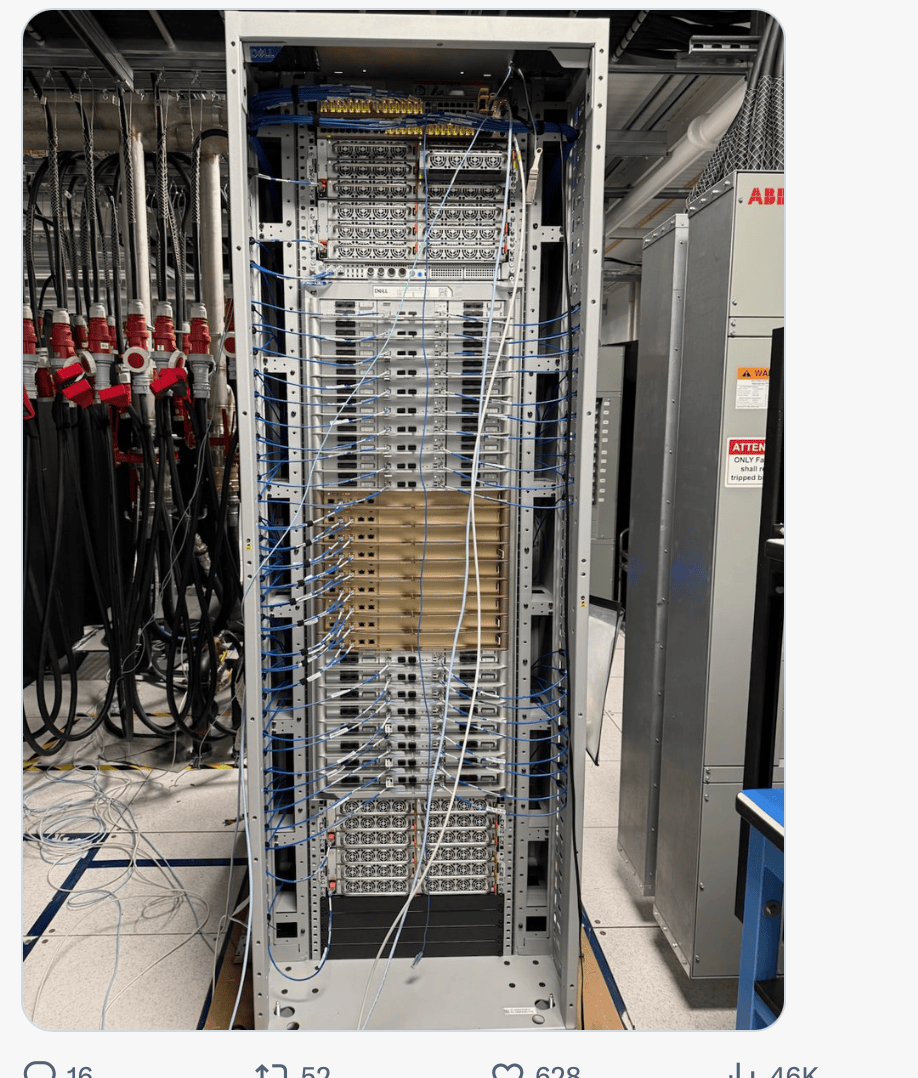
Beyond the precious. Price $7-$8M which includes circa $1.3M in 'memory'. It's early! Each rack requires 20.7 TB of HBM4. Micron is in 'mass production' phase-all sold out until 2028 at least

-
Uber, Autobrains, and NVIDIA are teaming up to launch a robotaxi pilot in Munich (pending approval).
Uber brings the ride-hailing platform, Autobrains provides the self-driving software, and NVIDIA supplies the DRIVE Hyperion hardware that supports Level 4 autonomous driving.
Level 4 basically means the car can handle all driving within a defined area without human input, but it still operates within limits like mapped regions or specific conditions. No driver needed in those zones, but it’s not fully “anywhere, anytime” autonomy yet.
The big idea here is scale: instead of one company building a closed system, they’re pushing an OEM-agnostic setup where different car manufacturers can plug into the same stack and join Uber’s network.
-
Headline-Cathie Wood loads up on Nvidia, cuts AMD across flagship ARK funds.
Cathie sold out of Nvidia before the run in 2023 and spent the next 2.5 years calling it over valued -she sold at between $14-$20 and now she 'loads up'.
-
Nokia (NOK) said it has developed the telecom industry's first commercial artificial intelligence-powered radio access network (AI-RAN) platform in collaboration with Nvidia (NVDA), a move aimed at significantly increasing the amount of data mobile operators can transmit over their existing network infrastructure.
The development comes less than 10 months after the two companies announced a strategic partnership, which also included Nvidia taking an equity stake in the Finnish telecom equipment maker.
Built on Nokia's AI-native anyRAN software and Nvidia's Aerial AI-RAN platform, the new system is expected to deliver more than a 100% improvement in spectral efficiency by 2028, effectively doubling the capacity of existing spectrum assets without requiring operators to acquire additional spectrum licences. The platform has already demonstrated more than 20% gains in spectral efficiency through AI-driven radio innovations, Nokia said in a statement on Wednesday.
Nokia's AI-RAN solutions will enter pilot deployments later this year before becoming commercially available in 2027, with a roadmap built around Nvidia's programmable silicon platforms.
"Telecommunications is entering the AI era — the radio access network is the next AI infrastructure," said Nvidia founder and CEO Jensen Huang. "Together with Nokia, we are bringing NVIDIA CUDA and AI into the baseband, transforming RAN into a planet-scale AI computer. This is a generational shift for operators — unlocking more capacity and efficiency from today's spectrum while creating the foundation for new AI services and the 6G era."
The announcement positions Nokia at the forefront of one of the telecom industry's biggest technological shifts. If the promised efficiency gains are achieved in commercial networks, operators could dramatically increase network capacity while reducing the need for costly infrastructure upgrades and additional spectrum purchases. -
Nvidia-backed $500b AI financing structure
The $500b is not a USD 500b Nvidia loan facility. It is a target for third-party capital mobilised through financing platforms involving Nvidia and major financial institutions.
Structure:
Institutional capital
↓
Apollo / Blackstone / KKR / BlackRock / Brookfield / Goldman Sachs
↓
AI infrastructure financing
↓
AI cloud providers / data-centre operators
↓
Purchase of Nvidia GPUs, networking and infrastructure
↓
AI customers generate compute revenue
↓
Customer payments service the financing
Nvidia’s role is primarily to enable and de-risk the financing, rather than fund the entire build-out itself. In some structures, Nvidia can provide residual-value support of up to around 25% of project value, helping protect financiers if the underlying equipment is worth less than expected.
The model therefore allows Nvidia to sell GPUs upfront while institutional capital finances the customers buying them.
The crucial point: $500b refers to capital that could be mobilised over time, not USD 500b of Nvidia debt or guarantees.Burry is crying foul

-
It's a school day!
Nvidia is moving its future AI data centres towards an 800V power architecture, and the reason is pretty simple: the amount of power these systems need is getting ridiculous.
Today's AI racks typically use much lower-voltage power distribution(sub 60V), but as Nvidia moves towards racks needing hundreds of kilowatts, and eventually around 1MW(that's super massive-1 rack using the power of 600 houses!), the amount of current required becomes enormous. At 800V, you can deliver the same amount of power using far less current.
That brings some pretty big benefits. You need less copper, thinner cables and smaller busbars, which saves space, weight and cost. More importantly, lower current means much lower electrical losses, because resistive losses rise with the square of the current. So there is less energy wasted as heat.The 800V approach should also allow Nvidia to simplify the power chain, with fewer stages of voltage conversion. That improves efficiency and reduces the amount of power infrastructure taking up valuable space in the rack, so they can stuff more GPUs inside

Ultimately, it's about making much more powerful AI systems practical. As racks move towards 500kW and eventually 1MW, the old architecture becomes increasingly difficult to manage. 800V gives Nvidia a much more scalable way of delivering all that power efficiently.
-
What do we think these boys will report on Wednesday?
-
Record numbers
Revenue hard to say really however several tail winds. Blackwell yet to peak/firing. Vera Ruben mass production.
Demand exceeds supply
China H200 albeit modest.I think they could report close to $95B. The Guide will be at least +$10B over the reported Nr.
I think the QoQ rhythm is now in the range +$15B. If you go back we predicted $100B quarters by end of 26-early!Margins 75-76%. The transition to Ruben will always see a small initial margin compression due to yield. Corrects back end of the year.
Operating Margin 62%
Net income margin circa 55% (tax paid earnings margin)Nvidia has trailing growth rate of 80% and a realistic fwd of 45-50% over several years.
-
Ignoring any revaluation of investments-operationally we expect the following when Nvidia report fiscal Q2 earnings after the close tonight! Expect Jensen to say Vera Ruben is in full production and demand for it is the highest in their history+ Blackwell has yet to peak.
Our expectations
Revenue $95–96B
Gross margin 75–76%
Operating margin ~65%
Operating income ~$62B
Underlying net income ~$51-53B (EPS $2.12-$2.15) excluding MTM on investments
Q3 revenue guidance $107–108B
In summary:
$95–96B revenue / 75–76% GM / ~65% operating margin / ~$62B operating income / ~$50B underlying net income / $107–108B Q3 guide.
For reference, current market expectations are around $92B for Q2 and $104B for Q3, so this would be a clear beat+raise -
So the naysayers will obviously state that the bubble will burst soon as they only made 62B
-
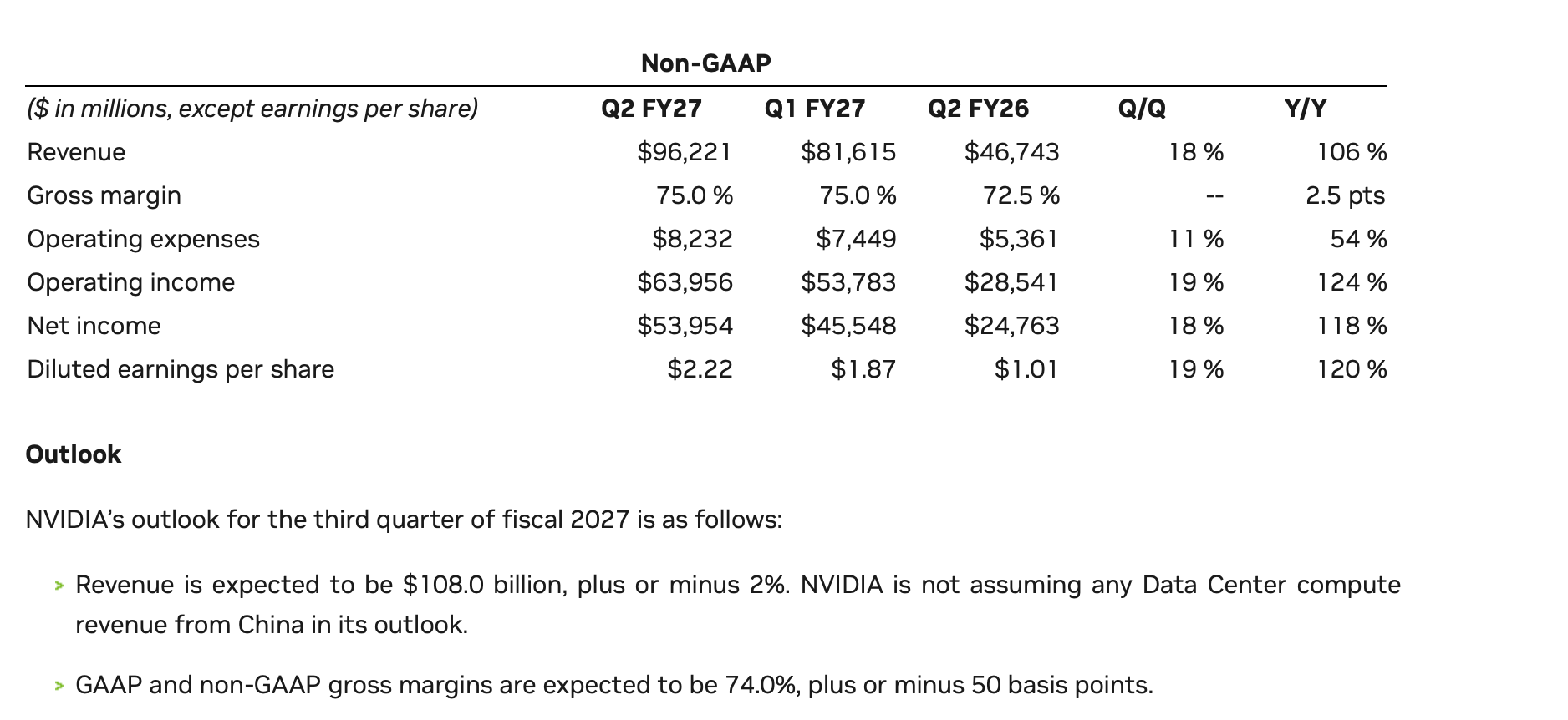
Results are as noted above. 96b revenue. Margin check. Guide, check.
-
Here is the result-it's fantastic and way better than consensus.
Revenue CHECK
GM CHECK
Operating Income 64b (+2)
Net Income 54B-
The guide was $108B CHECK!
100% growth people and a sub 20 multiple.And the icing on the cake. Nvidia said it is facing “extreme” memory costs and supply constraints, which are affecting its gross margins. Reports from the call say Nvidia expects those costs to pressure margins into the next quarter. Micron popped $30 AH. Nvidia $9-$10
Im not concerned about Nvidia margins as they intend raising prices 15% in Jan 27
-
the CFO said they expect 70% revenue growth in fiscal 2028

would be 100% if not constrained.
