
Micron Technology
-
Some spot price updates. Memory prices are up strongly.
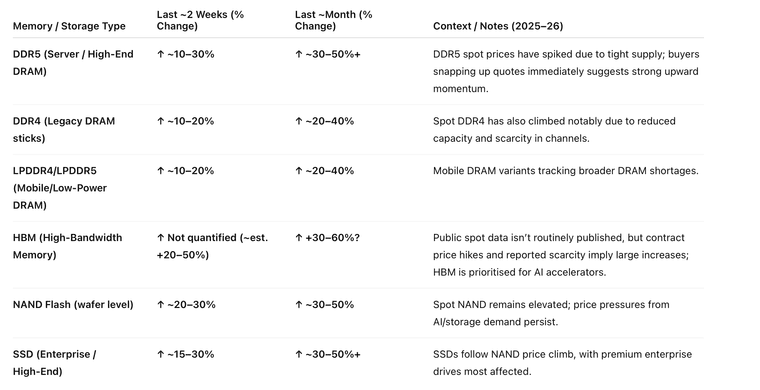
This is a great environment for Micron, full stop.
Memory pricing is rising across DRAM, HBM, and NAND at the same time that AI demand is structurally stronger than past cycles. That combination is rare. Supply is tight, not just because demand is high, but because manufacturers are disciplined and prioritising high-margin products.Micron directly benefits from that discipline through higher ASPs, better mix, and operating leverage. AI servers are memory-hungry, and Micron is selling into the exact parts of the stack where customers care more about availability and performance than price.
That translates into real pricing power, not promotional volume. Unlike previous upcycles driven by PCs or phones, this one is anchored in data centre capex, which is larger, longer-lived, and stickier. Margins expand faster than costs, inventories remain lean, and earnings rebound strongly.
-
Insiders sell for all sorts of reasons but buying at ALT and with conviction sends a much stronger message.
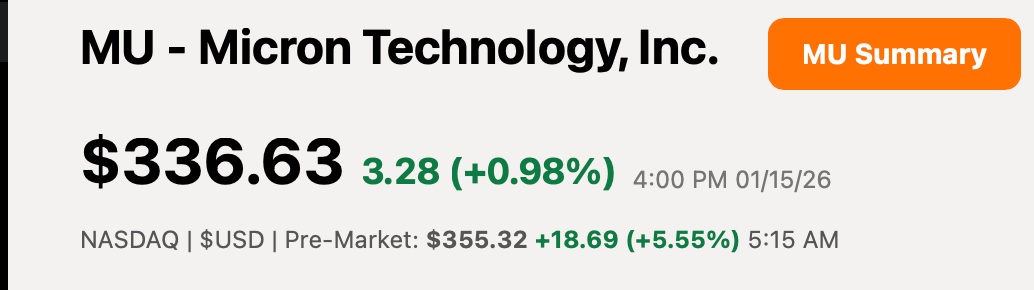
—Shares rose after the company disclosed that its director, Teyin Liu, bought 23.2K shares of common stock in a total transaction size of $7.8M. The purchases were made at prices ranging from $336.63 to $337.50 per share.
-
Micron will buy Powerchip’s Tongluo fab in Taiwan for US$1.8 billion, giving it cleanroom space of 300,000 square feet in a 12-inch (300mm) fab, to boost capacity amid growing global memory chip demand, Micron said. The firms inked a letter of intent and will close the deal by the 2nd quarter this year, and Micron expects the acquisition to contribute meaningful DRAM output in 2nd half-2027
-
Investing in the future
Today, Micron broke ground on our $100 billion leading‑edge memory manufacturing complex in Onondaga County, NY! With up to 4 fabs, it will be the largest U.S. semiconductor facility, generating 50,000 jobs in New York.
Made possible by strong partnership across government, industry, academia, and our local community, this project will be home to the most advanced memory manufacturing in the world
-
Taiwan DRAM makers Winbond and Nanya Tech are signing long-term contracts thru-2030 using a “locked volume, floating price” method, which put a ceiling on profitability, media report. They now require a 2-year minimum contract, up from 1-year, previously.
Micron Technology's future growth appears almost assured through 2028–2030, driven by structural AI demand for high-bandwidth memory (HBM) and advanced DRAM, persistent supply shortages, and the company's strategic positioning.Micron's CEO has stated that tight conditions in DRAM and NAND will persist through and beyond 2026, with the company able to meet only 50–66% of customer needs amid exploding AI data centre requirements. HBM, crucial for AI accelerators, consumes three times more wafer area than standard DRAM, creating a supply vacuum. Micron has sold out its entire calendar 2026 HBM supply (including HBM4), with multi-year agreements securing pricing and volumes.
The HBM total addressable market (TAM) is forecast to grow at ~40% CAGR from ~$35 billion in 2025 to ~$100 billion by 2028—two years earlier than prior estimates—and larger than the entire DRAM market in 2024. This trajectory supports sustained high margins and revenue visibility, as AI infrastructure build-outs (e.g., hyperscalers like Microsoft, Google, Meta) drive insatiable demand.
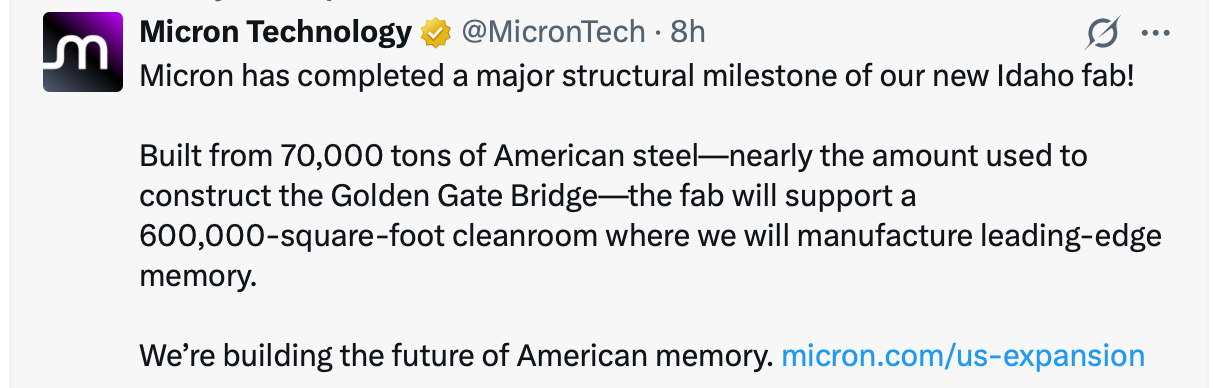
Micron is aggressively expanding capacity: Idaho fabs start output mid-2027 (with a second by end-2028), and a New York fab breaks ground in 2026 for supply in 2030+. Fiscal 2026 capex rises to ~$20 billion, prioritising HBM and advanced nodes like 1-gamma DRAM. Analysts project revenue near $75–77 billion for 2026 (up sharply from recent quarters), with consensus EPS around $33(far too low imo > $40, maybe $45, implying strong profitability.While memory remains cyclical, the AI supercycle—potentially extending to a $1.2 trillion market by 2030—shifts dynamics towards secular growth for leaders like Micron. Risks include potential oversupply post-2027 or AI capex slowdowns, but current shortages, sold-out high-margin products, and limited new capacity until late-decade make robust expansion highly likely through 2028–2030.
-
Taiwan DRAM makers Winbond and Nanya Tech are signing long-term contracts thru-2030 using a “locked volume, floating price” method, which put a ceiling on profitability, media report. They now require a 2-year minimum contract, up from 1-year, previously.
Micron Technology's future growth appears almost assured through 2028–2030, driven by structural AI demand for high-bandwidth memory (HBM) and advanced DRAM, persistent supply shortages, and the company's strategic positioning.Micron's CEO has stated that tight conditions in DRAM and NAND will persist through and beyond 2026, with the company able to meet only 50–66% of customer needs amid exploding AI data centre requirements. HBM, crucial for AI accelerators, consumes three times more wafer area than standard DRAM, creating a supply vacuum. Micron has sold out its entire calendar 2026 HBM supply (including HBM4), with multi-year agreements securing pricing and volumes.
The HBM total addressable market (TAM) is forecast to grow at ~40% CAGR from ~$35 billion in 2025 to ~$100 billion by 2028—two years earlier than prior estimates—and larger than the entire DRAM market in 2024. This trajectory supports sustained high margins and revenue visibility, as AI infrastructure build-outs (e.g., hyperscalers like Microsoft, Google, Meta) drive insatiable demand.
Micron is aggressively expanding capacity: Idaho fabs start output mid-2027 (with a second by end-2028), and a New York fab breaks ground in 2026 for supply in 2030+. Fiscal 2026 capex rises to ~$20 billion, prioritising HBM and advanced nodes like 1-gamma DRAM. Analysts project revenue near $75–77 billion for 2026 (up sharply from recent quarters), with consensus EPS around $33(far too low imo > $40, maybe $45, implying strong profitability.While memory remains cyclical, the AI supercycle—potentially extending to a $1.2 trillion market by 2030—shifts dynamics towards secular growth for leaders like Micron. Risks include potential oversupply post-2027 or AI capex slowdowns, but current shortages, sold-out high-margin products, and limited new capacity until late-decade make robust expansion highly likely through 2028–2030.
@Adam-Kay said in Micron Technology:
Risks include potential oversupply post-2027 or AI capex slowdowns ...
This kinda raises the question of when will the world stop spending big on AI? The current increase in expenditure on this particular tech will slow down eventually - it has to slow down - but when will the world have enough AI? When and where will it plateau?
-
When AI becomes self aware!!
I’ve seen the documentary with Arnold Schwarzenegger
-
Whenever anything 'grows' a question asked my many will always be 'when will the music stop'. It's a speculative question which is ill posed and isn't analytical. Spending won't stop and it may not plateau. It can't grow at 200% for ever nor is that necessarily important.
Near term, say 2 years, results are irrelevant. The investment will be made. Longer term more monetisation and LLM progress is important.
I don't think of it in terms of 'AI'. More HPC. For now and over the next 2 years I see little derailing the investment-our job is to keep our finger on the pulse and looking ahead to the next visible time frame. Our goal is to stay informed, stay consistent and stay focussed on the companies and the people that run them.
-
When AI becomes self aware!!
I’ve seen the documentary with Arnold Schwarzenegger
@Renmure-Jim said in Micron Technology:
When AI becomes self aware!!
I’ve seen the documentary with Arnold Schwarzenegger
I thought that was Will Smith
-
Micron Breaks Ground on $24 Billion Advanced Wafer Fabrication Facility in Singapore
Micron has broken ground on a new advanced wafer fabrication facility at its existing NAND manufacturing campus in Singapore, marking a major expansion of its global manufacturing footprint. The project represents a planned USD 24 billion investment and underscores Micron’s long-term commitment to Singapore as a strategic semiconductor hub.
The facility will be Singapore’s first double-storey wafer fab and is designed to deliver up to 700,000 square feet of cleanroom space when fully built out. Initial wafer production is scheduled to begin in the second half of calendar 2028, with capacity ramped in phases to match market demand.
Once operational, the fab will manufacture advanced 3D NAND memory wafers, supporting Micron’s latest and future generations of storage technology. Output from the facility will serve applications across AI infrastructure, data centres, enterprise and consumer solid-state drives, and mobile devices, where demand is rising rapidly due to data-centric and AI workloads.The new fab will form a core part of Micron’s NAND Center of Excellence in Singapore, providing critical capacity for ongoing technology transitions. Co-locating R&D and manufacturing is expected to improve efficiency, accelerate time-to-market and strengthen collaboration with academic and industry partners.
Micron also confirmed that its previously announced high-bandwidth memory (HBM) advanced packaging facility at the same site remains on track to contribute to HBM supply in calendar 2027, creating potential synergies across NAND and DRAM operations.
-
SK Hynix just reported, blowing away estimates and delivering new record revenue, margins and earnings, upped their dividend and share buy backs. Capex is up materially. This can only bode well for Micron. I believe Micron and others are in negotiations with their customers to lock in supply for 2027.
Context. The new Rubin NVL72 which uses HBM4. Each GPU requires '8 stacks' at $500ish/stack, $6,400 X 72 before packaging and integration so it's a safe bet that every server rack contains $500K of HBM4! It's not hard to see this turning into a Gold-Rush. Micron is expected to grow 100% in 2026 and at least 50% in 2027 and still it trades at a PE of 10

have a good day, all

-
some real time SK Hynix management comments:
Other Metrics:
 Says growth momentum accelerated further in 4Q
Sees 1Q DRAM bit growth flat Q/Q
Sees 1Q NAND bit growth slight decrease Q/Q
Continues to consider US stock listing; no decision
Demand reflects HBM3E strength; “shares… roughly tripled since the start of September”Bloomberg insights:
 HBM3E exclusive supplier for Microsoft Maia 200, per South Korean media report
Korean chipmakers vying for HBM4 certification (MU already certified)
HBM market CAGR projected ~25% through 2030
planned 19T won chip packaging facilities in Cheongju
shift toward net cash; Moody’s upgrade in mid December
Citi: DRAM ASP expected +120% this year; NAND ASP +90% this yearMgmt. Commentary:
“There are no easy wins and levers from a supply perspective to meet this new demand driver.”
“Hyperscalers and AI customers are looking at what they are willing to pay… through a very different lens.” -
Jensen is in Taiwan this weekend, negotiating H200 production ramp for China. In an interview yesterday, JS said... Jensen Huang: “We need memory for… HBM memory for performance. We need LPDDR for low-power memory.”
Reporter: Is memory constraint an issue for NVIDIA this year?
Jensen Huang: “The entire supply chain is challenging this year because demand is so much more. Supply has been growing 100% every year, but demand is going faster than that. We are going to have a very good year.”
We are entering a Memory Supercycle
Micron is a massive supplier of HBM 3E and 4 along all forms of DDR. ASP are up materially and forecast to continue to rise at least 50% this year. Supply too is ramping very fast.
-
I thought it was dirt cheap at 90 and it was with a 6 multiple worst case but I didn't expect it to run 5X in 1 year and that's because no one saw the ASP explode 130%.
It's the realm of thematic investing. If AI wins then the suppliers will win and our job is to look for value. We purchased MU with proceeds from Twilio mainly and realised $140. Twilio is -ve 18% over this period. And look at Palantir, we discussed its obscene over valuation and that has only managed 17%.
Put it this way. Micron will earn $40B net in 2026 calendar. Palantir will be lucky to earn 1.5B but only a month ago they were valued the same and Micron has a growth rate 3X Palantir. In the next 2 years Micron is likely to earn $100B. Palantir would do well to match that in 25(and probably never will). Which is the better investment? It's not even close. A 10 year old could work that out.
I am genuinely excited to see what Nvidia report in a few weeks. It's going to be epic, imo
-
-
Micron Technology ($MU) is poised to gain market share in supplying DRAM and high-bandwidth memory (HBM) to Google and OpenAI, rather than aggressively pursuing Nvidia, which is notorious for squeezing suppliers' margins.
The next two years focus is on profit maximisation, with Micron making smart strategic moves.Evidence strongly supports this view amid the ongoing AI-driven memory boom.
Micron's HBM production for calendar 2026 is fully sold out, with agreements on price and volume completed, including for its industry-leading HBM4.
The company has gained HBM market share against rivals SK Hynix and Samsung, particularly after Samsung's compatibility issues with Nvidia's Blackwell chips, allowing Micron to capture share in high-margin AI segments.Hyperscalers like Google (via TPUs) and OpenAI drive massive demand, often paying premium prices in a supply-constrained market where shortages persist beyond 2026 and into 2027 or later.
While SK Hynix remains dominant for Nvidia, Micron benefits from allocations to Google/OpenAI ecosystems, where less aggressive margin pressure enables better profitability.Micron has pivoted strategically—exiting much of the consumer memory market to prioritise AI-grade HBM—boosting record revenues, gross margins (nearing 68%), and earnings. Analysts project explosive HBM growth, with the total addressable market reaching $100 billion by 2028 (earlier than prior forecasts), and Micron's DRAM/HBM momentum continuing strongly.
-
TD Cowen sees upside for Micron toward $60 in earnings per share in 2026, above the firm's prior bull case of $50. This opens the door for a $600 stock price over time, the analyst tells investors in a research note. The tightness in the DRAM market will last for multiple years, the analyst tells investors in a research note. The firm expects a "gradual re-rating path" toward 12-times earnings on a "normalied" $50 per share earnings power.
Crazy numbers and a great example how the market totally mis priced Micron with analysts estimating a mere $20 eps only 9 months ago. We suggested $45. I also think as the growth reveals itself to be more structural(and we believe it is) this low multiple should expand.
Feb 11(tomorrow)-MU have an investors conference/fireside chat format so we will receive an update on how they are progressing
Something else I noticed. Pundits are quick to point out Microns 'historical' PE being in the 10-12 range. What they are missing is that is an average and at certain periods of glut a few years ago they made no money at all and or losses, i.e the multiple was negative! A very good example as to why you don't just accept a number as fact without digging into why. Micron has often traded at a PE of 20X and I believe it can get there in time. And why not if it keeps delivering growth, which we believe it will, in spades.
-
Just a reminder. The recent days set piece by Semi Analysis stating Nvidia havent ordered HBM4 from MU which is causing the softness, is intentional and conflated. The first HBM4 chips are needed by March/April. Micron have always planned for an H2 ramp, so stating they aren't included is just stating the obvious. They never planned to be. But SA have presented their (rag) article in a way to sew the seeds of doubt.
The CEO is presenting tomorrow and I am sure he will put this FUD to rest.
Micron Chairman Sanjay Mehrotra comments in Dec in conjunction with Q1 reporting : "We have completed agreements on price and volume for our ENTIRE CALENDAR 2026 HBM SUPPLY, INCLUDING MICRON'S INDUSTRY-LEADING HBM4.
.We forecast an HBM TAM CAGR (COMPOUND ANNUAL GROWTH RATE) of 40% through 2028 from approx. $35 billion in 2025 to around $100 billion in 2028 (projected to arrive two years earlier than our previous outlook.".
MICRON'S HBM4, WITH INDUSTRURY LEADING SPEED of over 11 Gbps, is on track to ramp with high yields in the second calendar quarter of 2026. -
The Wolfe conference starts at GMT 1.50pm today.
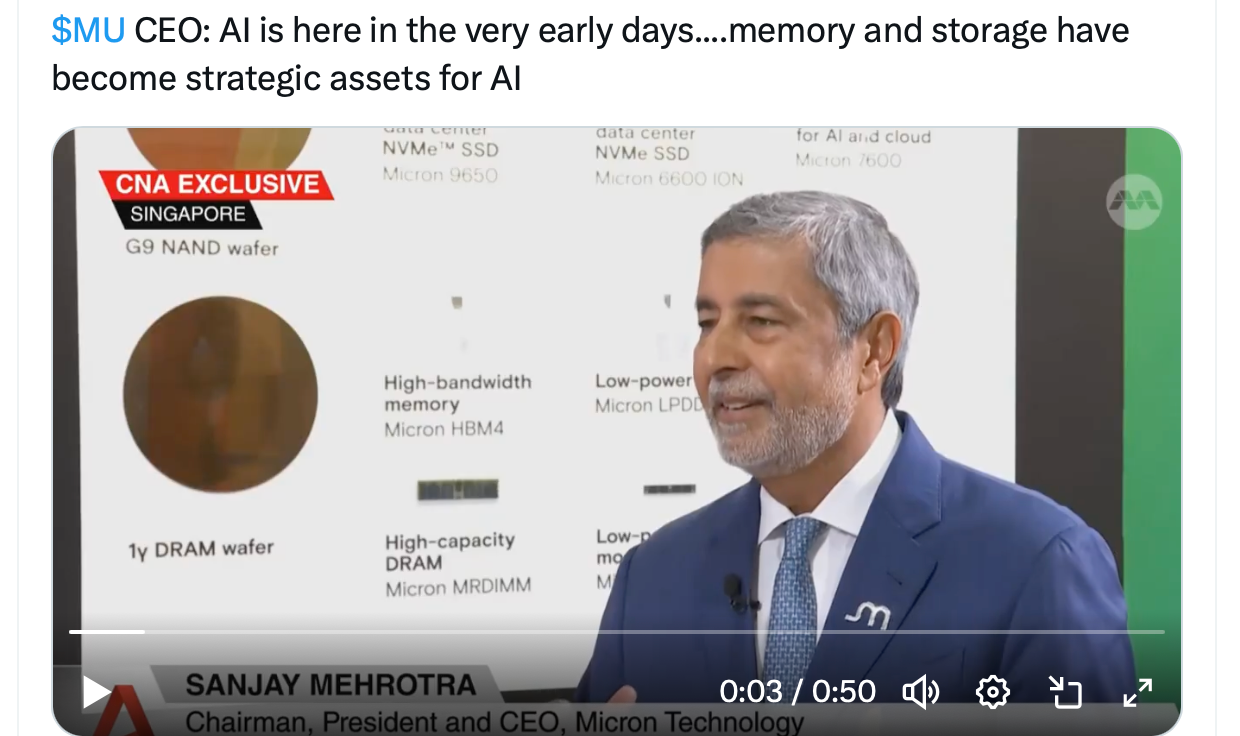
Buyers feeling that the CEO (Sanjay Mehrotra) will reaffirm the super positive narrative and dispel the rumours?
Not only is Sanjay an exceptional business leader, he is also a gifted engineer, holding Masters degrees in Engineering and Computer Science from Berkley and further Business programmes at Stanford. He co-founded Sandisk (SNDK) and holds 70+ patents in non volatile/flash memory. He is what drew me to Micron.
He is a giant in the memory sector who is very direct and I fully expect him to shut the door on any negative rumours.

