
Micron Technology
-
@Adam-Kay said in Micron Technology:
It’s up 10% after hours. And frankly that’s a joke.
As in it shouldnt be up that much?
@Slow-Horses A beat and raise like that imo deserved 50%
-
@Slow-Horses A beat and raise like that imo deserved 50%
@Adam-Kay said in Micron Technology:
@Slow-Horses A beat and raise like that imo deserved 50%
wowsers!
-
just my opinion

-
What’s your thoughts on the reports I was seeing yesterday regarding no shortage of memory and potential price fixing
-
post up the link and I'll take a look
-
Surely the timing of such news is opportunistic at best? https://www.pacermonitor.com/public/case/65375103/Garciaguirre_et_al_v_Samsung_Electronics_Co,_Ltd_et_al
-
I think the law suit is a joke-the plaintiffs are a group of retail consumers upset at paying higher prices.
I think they will fail at the first hurdle 'motion to dismiss' because they need evidence and in today's Information Age it's obvious there is a severe shortage. It's not worthy of any more time imo. The lawyer involved is part of a 'firm' with 8 staff.Micron will likely retain Simpson Thacher & Bartlett an elite global firm with a formidable team. Between opposing counsel there will be significant disparity in size, resources, and defense experience. I expect the lawsuit to be tossed.
-
just in....Korea's memory semiconductor industry is understood to be pushing to raise the average selling price (ASP) of commodity DRAM in the third quarter of this year by as much as 20% versus the prior quarter.
With supply shortages persisting across the entire product lineup on the back of AI infrastructure investment, memory makers are interpreted to be extending a strategy of maximizing profitability. The pace of price increases will slow thereafter, but industry sources say an extremely high profitability trend will continue into next year as well.
According to the industry on the 3rd, Samsung Electronics is in negotiations with customers targeting a Q3 DRAM ASP increase of up to around 20% versus the previous quarter.
SK Hynix is also believed to have entered long term contracts with customers but are demanding deposits up to 30% and have removed all price caps.
-
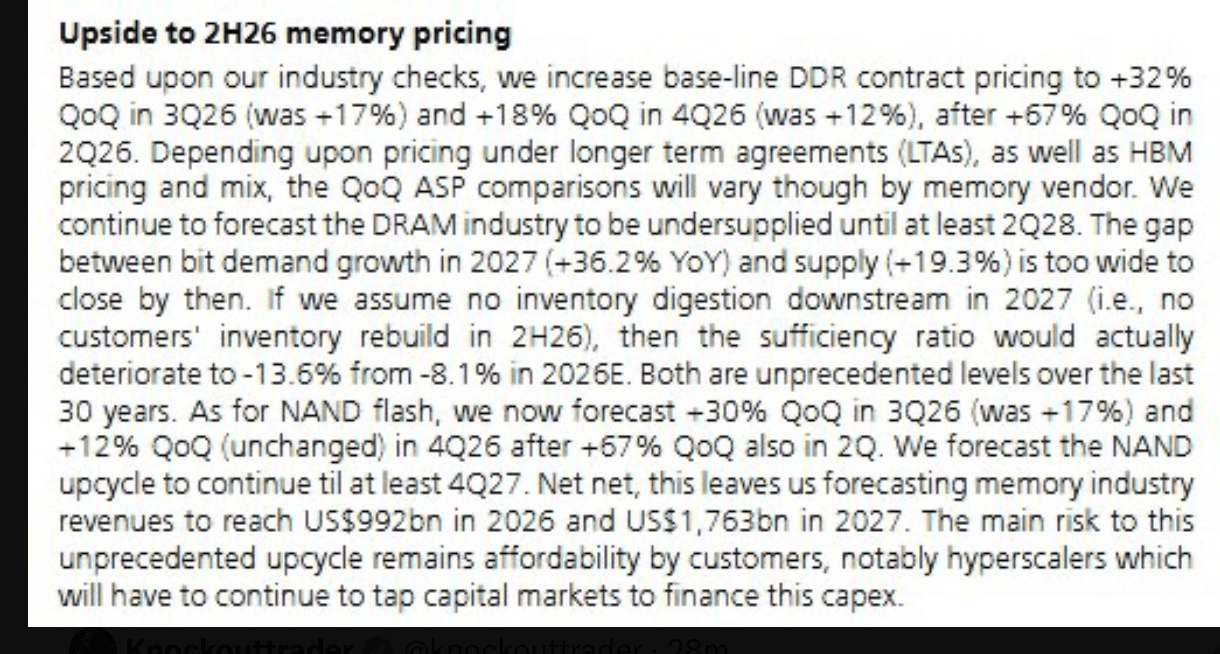
UBS raises its DRAM and NAND price forecasts even more
DRAM prices are now expected to rise 32% QoQ in Q3 and 18% QoQ in Q4.
NAND prices are expected to rise 30% QoQ in Q3 and 12% QoQ in Q4.
Note anticipated supply increase (+19.3%)-this is the industry, however Micron is growing bit supply by at least 25%-30%-minimum 6%+ per Q. Second point +36% demand grow, ergo the gap widens. I think +36% is very low. Imo it's > 50% simply due to rack density and number of racks shipped. Third point 2027 revenue for 'memory' forecast +78%. I also disagree with the forecast that supply catches up with demand in the second half of 2028-the industry and even large customers expect 2030 earliest.
-
Nvidia’s New Racks and the Memory Crunch
Nvidia’s Rubin platform, combined with the CMX (Context Memory eXtreme) storage architecture, marks a significant advancement in AI inference infrastructure. Each Rubin rack integrates numerous next-generation GPUs with BlueField-4 networking and substantial flash-based context storage. Per-rack NAND/SSD capacity typically reaches 1,000–1,200+ TB, with SuperPOD configurations scaling to tens of thousands of TB.
For NAND, the implications are profound. CMX-driven demand is projected to surge from around 35 million TB in 2026 to over 100 million TB in 2027, effectively adding an Apple-scale buyer to the market. Even as the industry adds some bit supply growth (around 20% in 2026), the gap between demand and supply is expected to widen. New wafer capacity from major players, including Micron, will not ramp meaningfully until late 2027 or 2028. This mismatch points to more severe shortages, sustained high utilisation, and further upward pressure on prices — particularly for enterprise and high-capacity QLC SSDs.
HBM faces similar strain. Rubin GPUs demand significantly more HBM4 per unit than previous generations, pushing rack-level requirements into the multi-terabyte range. HBM supply remains largely sold out through 2026 and into 2027 via long-term contracts.Overall, Nvidia’s new racks intensify the memory supercycle. Despite modest supply growth, explosive AI-driven demand will likely exacerbate shortages, supporting higher pricing and strong margins for suppliers like Micron well into 2027 and beyond. The structural imbalance favours memory producers in the near term.
-
Even with aggressive greenfield fab investments, ongoing memory shortfalls for a decade or more remain highly probable. SK Hynix CEO Kwak Noh-jung has warned that 2027 will bring the industry’s most severe memory supply crunch yet, with demand outstripping supply well beyond 2030. This assessment holds despite major capacity expansions. While SK Hynix, Samsung, and Micron are pouring billions into new fabs and advanced packaging, the timeline for new greenfield sites is inherently long — often 3–5 years from groundbreaking to meaningful output.
Edge AI in cars and robotics accelerates this mismatch. Millions of autonomous vehicles needing 300GB+ per high-end unit, combined with scaling humanoid fleets (each requiring substantial HBM/DRAM for real-time multimodal AI), add explosive incremental demand on top of insatiable data centre needs. HBM products are already sold out through 2026, and producers continue prioritising the highest-margin AI accelerator customers.New capacity helps at the margin but struggles to match the compound annual growth in AI-driven memory consumption across cloud, automotive, and physical robotics. Efficiency gains (model compression, new architectures) offer some relief, yet they rarely outpace capability demand — more powerful edge models simply consume more memory per device as autonomy and dexterity targets rise.
The result: structural tightness persisting into the mid-2030s. Expect elevated prices, allocation battles, delayed product ramps, and higher costs for edge AI deployments. Greenfield sites mitigate but do not eliminate the decade-long imbalance SK Hynix leadership has highlighted.
-
Morgan Stanley’s Joseph Moore said, today, that, after speaking with several purchasing contacts in the data centre space last week, the intensity of the memory shortages shows no signs of abating. He added that prices appear to be up at least 25% on a like-for-like basis from 2Q to 3Q.
This is above both Morgan Stanley’s and third-party estimates.
Moore also noted that longer-term concerns that the memory shortage will intensify in 2027 and again in 2028 remain as strong as ever. Morgan Stanley added that there is not enough memory relative to AI requirements and that it does not see this situation changing.
Notable quotes:
“Cloud customers are paying premiums to the expected 2Q price for six-week expedites; do we think those customers are paying those premia to stockpile memory in a warehouse?”
“AI is consuming so much DRAM that there isn’t enough left over for other sectors, and everywhere we look, we see indications that it is a true bottleneck. It’s holding back PC builds and smartphone builds.”
“Memory is not just constrained by AI demand—memory is increasingly one of the major primary constraints on AI demand, along with space and power.”
AK-Alas the short sellers have done a good job of convincing retail investors to offload their shares by aggressively pushing the glut narrative, coming next year. Imo we are in for a decade of shortages.
-
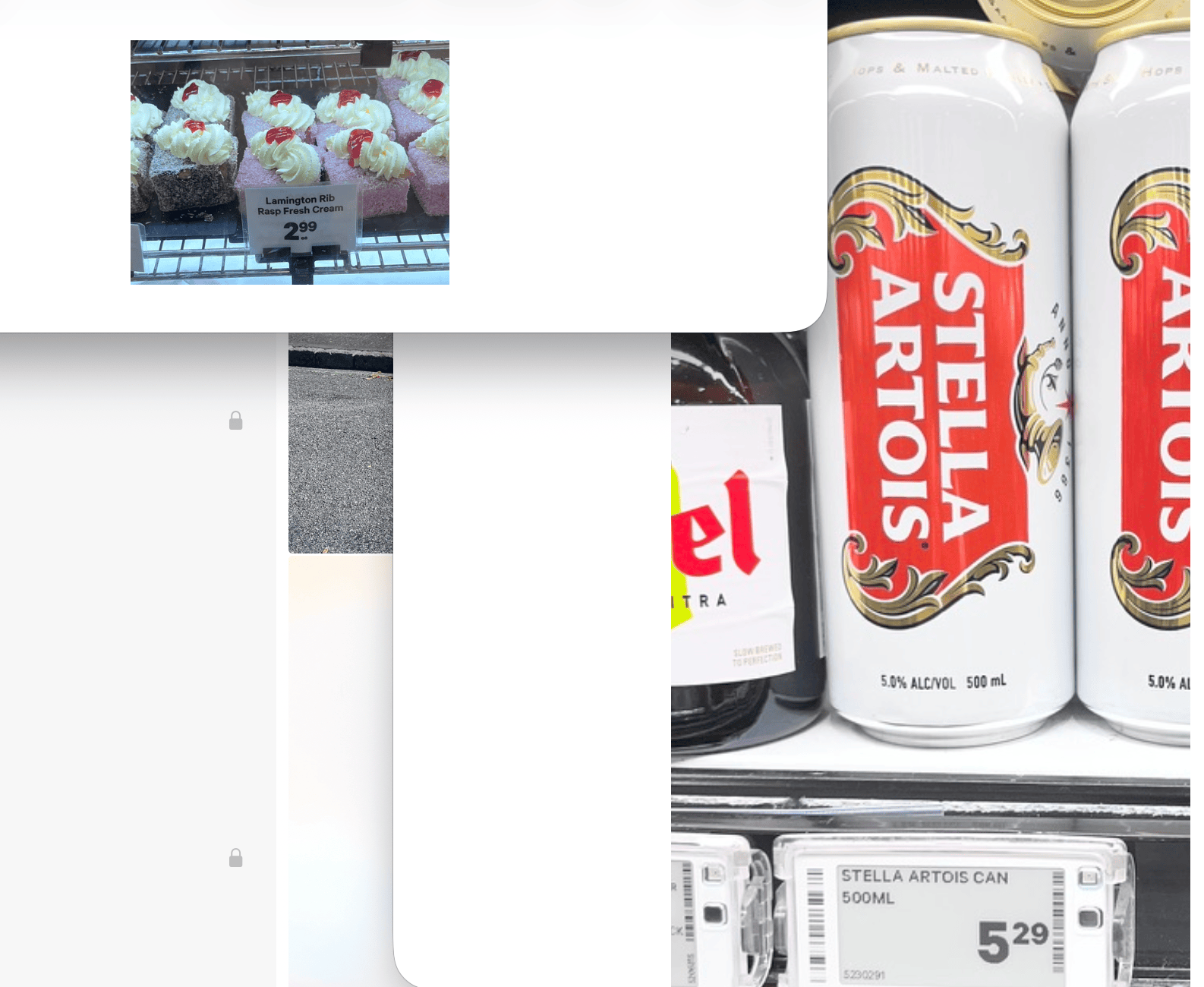
I was just there-lucky it's now winter $45 sunscreen, $5 cans of beer but the national cakes looks cheap
-
Looks like this CMXT is being used to give Micron a bloody nose …anything in it ?
-
In CXMT causing mu a problem. No. But if you say it enough some believe it
-
To add to the above.CXMT makes low end Dram for the domestic market. The money is in HBM, DDR5 and soon 6, plus enterprise flash, SSD. Reality, they will likely fail Apples validation for lower end Chinese iPhones. And no chance it will be allowed into the US. Almost nochance they will produce HBM and if they could, tiny volumes and even then won’t get into Western DC. The FUD is a Burry/short narrative. Micron is sold out for 2-3 years and imo will see a decade of surplus growth.
I see the volatility as nothing more than opportunistic traders, gamblers pushing it around.
-
SK Hynix Q2 2026 Earnings Summary (Demand & Supply)SK Hynix reported record Q2 results with revenue of ~$54.1 billion (+51% QoQ) and operating profit of ~$41.6 billion (+61% QoQ), driven by strong AI demand and tight supply.
Demand: Robust and structural. AI infrastructure investments continue, broadening needs for HBM, server DRAM (agentic AI), and enterprise SSDs. The company expects DRAM demand to grow mid-20% YoY and NAND high-teens % YoY in 2026. Momentum is supported by AI service revenues, with no signs of slowdown.
Supply: Remains constrained. Customer demand exceeds capacity, especially for advanced products. Q3 guidance: DRAM bit shipments +~10% QoQ; NAND +low-single-digit % QoQ. Supply-demand balance unlikely to ease soon due to process complexity and long fab lead times.
Finalised LTAs with ~10 key customers for stability. Raising 2026 CapEx to high-KRW 40T range (~$28–32 billion) to accelerate capacity (HBM4 ramp, new facilities). Timely supply is a core competitive advantage.
-
Recent reports that the US government may investigate Chinese memory maker CXMT have significantly reduced the likelihood of Apple receiving approval to use its DRAM chips. US lawmakers are reportedly concerned about CXMT's alleged links to the Chinese military and broader national security implications, placing the company under increased political scrutiny.
Apple has explored sourcing DRAM from CXMT, particularly for iPhones sold in China, to reduce costs and diversify its supply chain. However, any approval would now face a far more difficult political environment.
The Trump administration would need to balance Apple's commercial interests against concerns over technology security, supply chain resilience and the strategic importance of supporting US semiconductor manufacturers.
Several outcomes remain possible. The administration could reject Apple's request entirely, permit CXMT memory only in devices sold exclusively within China, or impose strict conditions that severely limit its use. Given the current climate, broad approval appears considerably less likely than it did only weeks ago.
For existing memory suppliers such as Micron, Samsung and SK hynix, these developments are potentially positive. If Apple is unable to source meaningful volumes from CXMT, demand is more likely to remain with established suppliers. While the situation remains fluid, the latest developments suggest any significant disruption to the global DRAM market has become less probable in the near term.
