
Micron Technology
-
Thank you
-
Micron looks like its dropped another 11% today so far.
-
Micron looks like its dropped another 11% today so far.
@Jason-Knowles said in Micron Technology:
Micron looks like its dropped another 11% today so far.
Looks like it's DRAM kerfuffle rather than HBM, and I understand that HBM is where the $ is. Although that's uneducated guesswork from someone who doesn't know what he's talking about.
-
It's speculation the new Governors will somehow stop the build out. A ludicrous idea.
Firstly all of 27 and part of 2028 is already in construction-nothing happens (no change).
For some of 2028 and beyond im sure whoever builds them will have to deal with more bureaucracy (but actually it's more about who pays for what-eg build up 500 affordable homes and a power plant) but one way or the other the facilities will be built. All States compete for capital-capital means taxes and jobs. Politicians can say what they want to get elected but the reality is if any Governor decides to take the green route there will be a long line of others willing to take the money. It's common sense.No one wants to see days and weeks like these but we have seen them before. Just remember, this is pure knee jerk speculation against the back drop of unmet demand so high there is a long line of takers.
If DC X is delayed there are 5 more ready to jump in and get allocated 'sooner' than they thought.
-
The union of workers at US-based Micron Technology’s plant in Taoyuan, Taiwan, said it was withdrawing from further negotiations with the company on introducing a new profit-sharing system. The organisation acknowledged that its campaign had failed to achieve its goal, calling the outcome “our defeat.”
-
Just out-TrendForce expects HBM4 pricing to rise from at least $2.05 per Gb in 2026 to $3.00–$5.50 per Gb in 2027, and projects a year-over-year increase of more than 100%. Pricing discussions for next-generation HBM4E are at $5 per Gb or higher.
1β (1-beta) and 1γ (1-gamma) transition will actually improve margins. DRAM technology increases bit density by over 30%, meaning approximately 23% less silicon is needed per gigabit. And remember less silicon = lower cost

-
This and Nvidia results should bode well for MU earnings call later in December….or is that wishful thinking
-
Not at all wishful thinking-all the evidence points to the opposite. Micron will almost certainly smash their numbers and guide higher. And have 70B to buy back their stock(enormous)
-
Micron ($MU) – Sanjay's drop-the-mic moments at the TomorrowX Summit last week.
If anyone still thinks this is just another memory cycle, they really need to listen to what Sanjay is saying.
Some absolute bombshells:
2027 and 2028 will be even tighter than 2026. Not easing, getting tighter. Let that sink in.
75% of 2027 production already sold. And they're already negotiating supply agreements for 2028. Why not 100% you may wonder. Because prices are still rising so management hold back some capacity to negotiate even higher prices. Either way it's all sold out.
Customers want MORE than Micron is prepared to commit. Demand is so strong Micron is deliberately keeping capacity uncommitted. This customer request isn't for supply today it's over their 5 year SCA-they want Micron to agree to supply even more in 28 through 31. Micron will not guarantee it.
No visibility on when supply catches up with demand. So much for the inevitable collapse in 2027, then 2028, and now apparently 2029. Sanjay says we have no visibility as to when demand falls below supply-quite the statement. SK, Samsung say exactly the same thing.
26 strategic customer agreements, involving $32bn in upfront cash and commitments. Five-year deals, with pricing protections and take-or-pay provisions. This isn't the old memory market.
Memory is now mission-critical to AI. It's no longer simply about buying the cheapest DRAM. Performance, bandwidth, capacity and power efficiency are everything.
2027 expected to be stronger than record-breaking 2026. Sanjay sees no deterioration in demand.
Customers can't simply walk away from their contracts. Gavin Baker pushed Sanjay on what happens if AI demand drops 10–15%. Sanjay was clear about the strength of the contractual protections. Before anyone says demand will fall. In 2026 the data centre market added about 12GW of compute in North America. The existing commitment is +22GW in 2027 and more again in 2028. It's a done deal and it will be built. Why, because the hyperscalers have 2.48T in backlog(signed and sealed customer contracts)-they don't have enough compute. It's that simple.
Next-generation 3D DRAM is coming. Another potentially enormous opportunity from 2028 onwards. Micron’s 3D DRAM could be an absolute game changer. By stacking memory cells vertically rather than shrinking them horizontally, Micron could dramatically increase bit output per wafer while reducing costs per bit. Recall that the silicon is the expensive part-think sky scraper on a small piece of land!
Buyback restrictions expire 9 December. Micron can start deploying excess cash into shareholder returns. At these earnings multiples, the potential EPS leverage is staggering. This is the big one to watch. How much cash. Today they hold about $70B in surplus cash, growing at around 37B(+$5B) per quarter-not annually and all of it is being used to retire shares. The impact is going to be fundamental and almost unprecedented at this scale. Something like 2X Apple's massive buy backs over the last decade and starting from a MCap half that of Apple. Ergo 4X more leverage
-
keeping up to date (report today that Nvidia GPU are 26 weeks lead(demand so great)
The memory manufacturers are prioritising server DRAM to such an extent that Nvidia is reportedly having to cut gaming GPU production because of insufficient GDDR7 availability.
That implies:
- HBM supply is tight.
- Server DDR5 supply is tight.
- GDDR7 supply is tight.
- Consumer DRAM supply is being squeezed.
- Pricing power is spreading across the memory market.
Micron doesn't necessarily need to sell more bits to make more money. It can benefit from higher ASPs across its existing production.
This is precisely the structural shortage thesis we've been discussing. AI isn't simply consuming additional memory production — it's displacing existing demand across other industries.
-
It's nothing but speculation. Bears 'screaming fire in a crowded theatre'
I don't blindly form an opinion and hold fast to it. I'd challenge anyone to put forward a counter argument. EG. Yesterday a doom and gloom merchant stated that demand will fall and cited Mid Term elections as proof. What proof? Speculation that Dems are anti data centre. It's speculation based on some other inserted opinion dressed up as fact. It has no credibility whatsoever.
It's the same nonsense as citing the railroads or Cisco in the 2000s
We have discussed this. Share prices often don't = value.
-
Here is an example of peddling misinformation
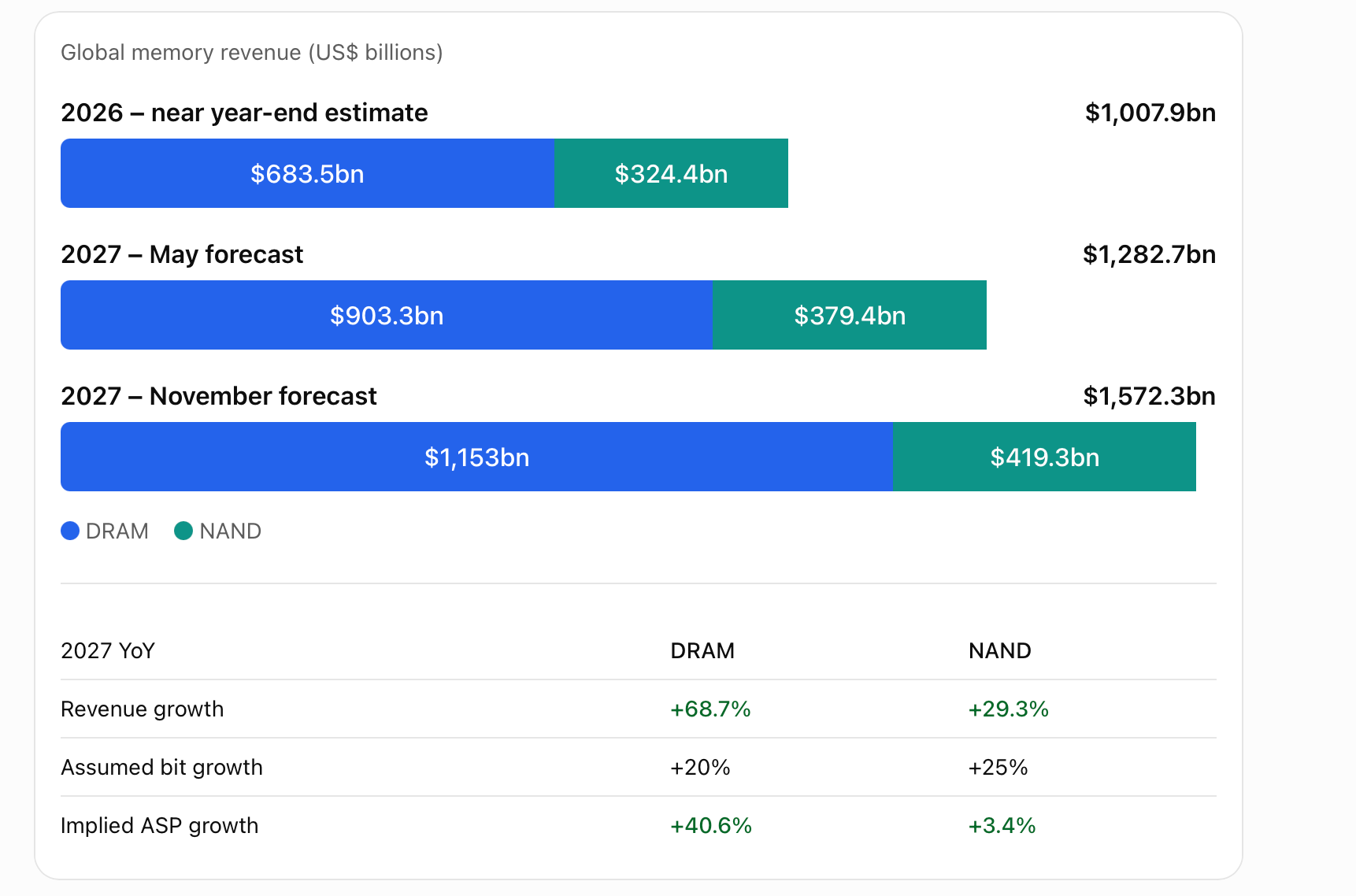
TrendForce's memory downgrade – or another dose of FUD?
Much has been made of TrendForce's supposed downgrade to its 2027 memory market forecasts. However, when you actually unpick the published reports, a rather different picture emerges.
May 2027 forecasts:
DRAM: $903.3bn
NAND: $379.4bn
November 2027 forecasts:
DRAM: $1,153bn
NAND: $419.3bn
That's a 27.6% upgrade to DRAM and a 10.5% upgrade to NAND, representing nearly $290bn in additional industry revenue compared with May's published forecasts.
Furthermore, TrendForce now expects DRAM revenues to grow by approximately 69% in 2027, compared with its previous published expectation of 46%.
TrendForce describes its latest revision as a downgrade against an intervening forecast, but hasn't publicly quantified that previous forecast. Crucially, its underlying research explicitly states that the overall DRAM demand outlook remains unchanged.
With assumed bit growth of 20%, the latest revenue forecast implies annual blended DRAM ASP growth of approximately 41% in 2027.
Yet some would have you believe that memory demand is deteriorating and pricing is about to collapse.
There is a world of difference between moderating price increases and falling prices, just as there is between slower growth and declining demand.
By all means discuss the risks, but at least present the numbers and the context.
Surprise, surprise – some appear more interested in peddling a bearish narrative than examining the underlying data.
The only quantifiable revision between the publicly disclosed forecasts we have identified is a substantial UPGRADE.