
Micron Technology
-
Just in from Semi Analysis-
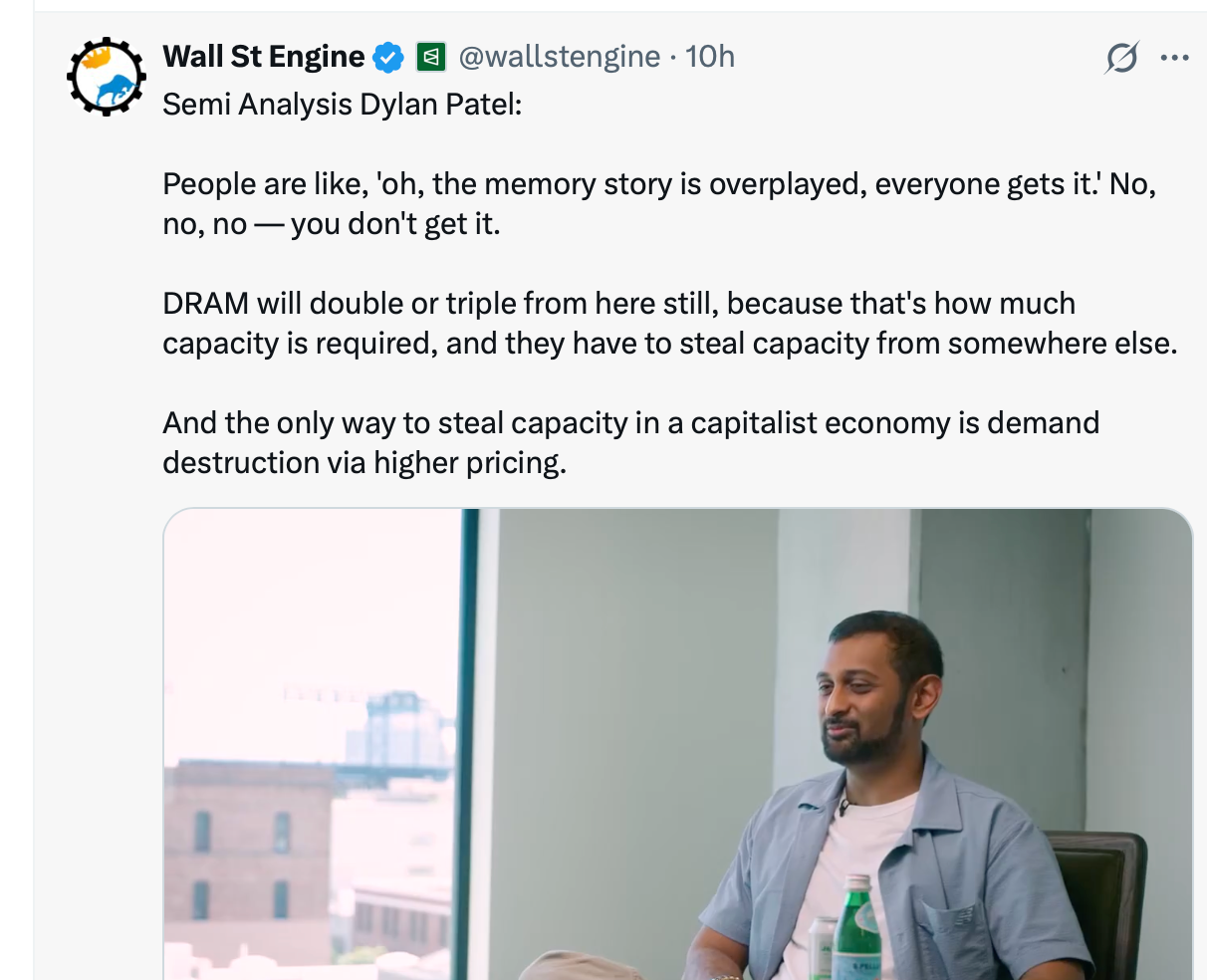
DRAM prices are expected to more than double in CY26, with another double-digit ASP increase in CY27
LPDDR5 contract pricing up over 3x since 1Q25. Price likely exceeds $10/GB in 1Q26 on the open market
HBM remains structurally undersupplied through CY27. AI-based servers already see significant % BOM costs from HBM, before price hikes
We know B200 server prices(Blackwell) are going up 15–20% by year-endMemory is a massive % of the $250B in incremental hyperscaler spend this calendar year. (2/4)I think the $33.5B revenue and $19.5 EPS guide is far too low!

-
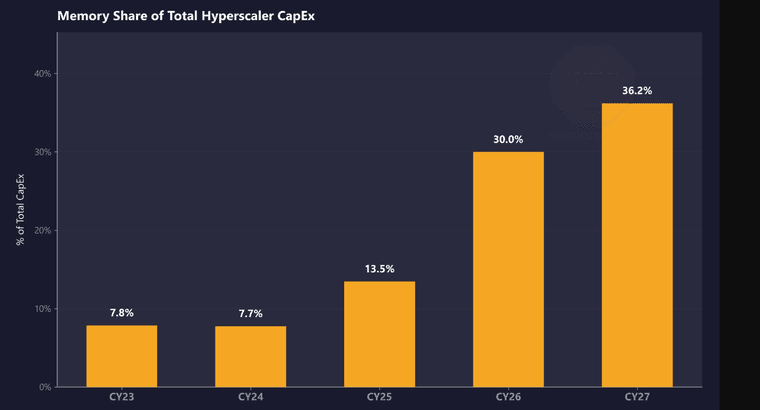
Quite incredible graphic showing 'memory' share of total Capex. It's gigantic. Recall we speculated some time ago that memory will be as important if not more important than the GPU. We need to pause and think about this for a moment. A $5M Rubin rack containing over $1M in memory. And the forecast is for 2027 to be even more. That GOOG Turbo algo sure killed the memory hype

-
And some guy …seeking Alpha reckons that Micron is a value trap ….dont buy the shares it’s worthless
-
There's always 'some guy' on the internet with an opinion.

The author compared the HBM market to 'Timmy's lemonade stand and some guy comes along with a lemon processing machine and 100Xs the supply'. I won't bother unpicking that analogy as it's moronically (tropic thunder).
All we need to know is management(who actually know what's going on) see blue sky as far as they could possibly see, are investing more(10s of billions) to meet the unmet demand they know they will not be able to meet. They think this will persist for years. They think existing 80%+ margins are the new norm. And the icing on the cake is the next 12 months will see min $100 and likely more EPS, it's not like this 300% growth comes with a high stock price, PEs in the 80-100 or more. It's 3.5. I like the math.
Further that article is factually wrong with the math. ROE stated at 50%(it's not), it's well over 100% and as a number-articles with a narrative always pluck/insert dubious figures with no basis and that's exactly what you have here. Lists the next years ROE, without any source or basis. I don't use ROE because it is deeply flawed. It's historical and the big one, it's an accounting concept not a business concept. It's taught in academic circles and imo useless in this case. EG if management paid out a huge dividend, Equity is reduced and the ROE looks far worse. But is the company valuation worse-of course not.
-
Given Samsungs +750% profit surge being all about memory, it's a reasonable assumption that Micron will move back over $400 today.
-
Analyst note today:
"Beyond Micron management’s statement that its 2026 HBM capacity is already sold out, the company’s HBM, DDR5, and LPDDR5 production capacity has now been fully reserved through 2027. We raise our target price to $825
With 2027 allocation now complete, Micron is currently in discussions with key customers regarding 2028 supply volumes and pricing terms."
-
Some memory stocks have gone up over 20X in the past 12 months and their valuations look modest-still
But you wouldn't even know about it if you weren't an Nvidia HPC believer. And look at Nvidia, lower PE than Coke, Walmart, Mcdonalds. Patience is a virtue-although no complaints here
-
Legacy DRAM shortages in SSDs are becoming severe (think sandisk). The three major DRAM makers(think Micron), which can self-supply legacy DRAM (DDR4) used in SSDs(they can produce their own), will gain a structural advantage in NAND as well(think historically MU has an advantage in DRAM, SNDK in NAND). However eSSD (critical) requires both and SNDK is tapped out-having to buy the memory components it does not produce on the open market. Micron can supply its own! Edge to Micron. We are in some sort of memory utopia
-
Trendforce just revised April DRAM contract price forecasts even higher. They bumped DDR5/DDR4 up by +18% and +23% respectively vs. the March estimates.
The contract prices to be announced at the end of April are expected to hit $37.5 for both DDR5 and DDR4 — that's +27%/+21% MoM gains.
Margins can only keep rising well into the 80s. Nice
-
Taken from the companies prepared remarks. Ignore the currency and focus on the percentages.
SK Hynix posted its highest-ever profitability in Q1, driven by an unprecedented memory supercycle. The operating margin reached 72%, placing the company among the top tier of global manufacturers. SK Hynix is highly likely to deliver record profitability again in Q2, as DRAM and NAND prices continue to climb and shipments expand with a shift toward higher-value products.
According to industry sources on the 23rd, SK Hynix is expected to set a new all-time high operating margin in Q2 on the back of the continuing memory supercycle.
In Q1, SK Hynix reported revenue of KRW 52.5763 trillion and operating profit of KRW 37.6103 trillion. Revenue rose 198% YoY and 60% QoQ, while operating profit jumped 405% YoY and 96% QoQ.
These results mark a record high for the company.
Memory bit growth in Q1 was limited — DRAM was flat QoQ and NAND declined roughly 10% QoQ. However, average selling prices (ASP) for DRAM and NAND rose by the mid-60% and mid-70% range respectively, driving a sharp expansion in profitability.
This was supported by rising demand for high-value server memory tied to AI infrastructure investment. Notably, excluding HBM — where price volatility is limited — commodity DRAM ASP is estimated to have increased by around 100%.
Q2 earnings are expected to expand further, as volume growth and price increases are set to materialise simultaneously.
SK Hynix guided Q2 DRAM bit growth to the high single digits and NAND to the mid-teens, with ASPs expected to continue rising. Current industry estimates place Q2 QoQ ASP increases at roughly 20% for DRAM and 30% for NAND.
A semiconductor industry source said, "Given current conditions, a sharp rise in memory prices through Q2 is all but locked in, and SK Hynix's operating margin is highly likely to set a new record high in Q2."
SK noted that HBM demand will not catch up to supply, at the earliest,- 3 years!
Looking at Micron, which is maintaining bit growth and ASP growth I would expect similar QoQ growth which translates to > $20 EPS for their current Q3 which covers the period March through May (Actually last day of Feb to June 4, although Im modelling 75% QoQ and closer to $23 EPS. Clearly whatever they deliver is expected to be exceeded again in Q4.
-
our model (ultra conservative) intentionally assumes ZERO ASP increases from next Q and would still have EPS grow 25% per annum from a new baseline of >$100 EPS (Likely $115). Where is the growth coming from? Node transition eg 1 gamma. Think of the Wafer as the expensive real estate-
A wafer is a fixed-cost batch of silicon that produces many chips. When process nodes shrink, each chip takes less area, so more dies fit on the same wafer. Smaller dies also tend to have fewer defects per unit, improving yield—the percentage of usable chips. This combination increases the number of sellable chips per wafer and lowers cost per chip. For memory, shrinking also increases bit density, meaning more data capacity per chip.
Micron also benefits from selling 'older' memory which is also in very high demand and with old lines the tooling and R&D is full depreciated which means higher margin! Win-win.
-
During Meta's earnings call. Zuckerberg said. ' “We are increasing our infrastructure CapEx forecast for this year. Most of that is due to higher component costs, particularly memory pricing.” (CEO Zuckerberg)
Good for Micron

-
Sandisk reported last night, beating EPS by $9-expected $15, reported $23 on 78% margins. Consensus guide was $6.5B but they blew that away with $8B at the midpoint and further margin expansion(80%). A guided 50% increase in EPS QoQ-not year. The stock actually came off the boil in AH which seems typical at the moment. The take away, it's a staggering result which bodes very well for the sector.
-
Some industry lingo and implications. 'Samsung strikes LTAs at 0.5
The 0.5 floor refers to Samsung’s minimum guaranteed price (floor) in its long-term agreements (LTAs) for enterprise SSDs (eSSDs), set above $0.50 per GB.LTAs are multi-year supply contracts, typically spanning three to five years, between Samsung and major customers such as cloud providers and hyperscalers. These agreements lock in committed volumes and include pricing protections, often with a floor price to ensure stability for the supplier.
According to recent analyst commentary, Samsung’s LTA floor sits above $0.50/GB. This is higher than expected quarterly pricing — for example, around $0.35/GB in Q2 rising to roughly $0.45/GB in Q3. The elevated LTA floor indicates that long-term contracts are being struck at premium levels compared with shorter-term deals.What this means is that long term contracts are placing a floor ABOVE current elevated spot prices.
NB. Drives like the PM1733a / PM1753 / BM1743 top out at 30.72 TB-that's 30,720 GB or > $15k. I'd estimate the manufacturing cost is somewhere between 2.5-$3k. Nice margins.
-
CEO Sanjay Mehrotra-fireside chat on Friday said......
The shift in AI memory TAM from a projected $100B by 2030 to roughly $100B today highlights how quickly expectations have been overtaken by reality. Sanjay Mehrotra pointed out that demand—especially tied to generative AI—has accelerated far beyond what the industry modeled even a year ago. Training large models was the initial driver, but inference at scale is now compounding the need for high-performance memory, particularly HBM. As a result, Micron Technology and peers are repositioning around a much larger opportunity. Mehrotra’s updated view of a $300B TAM by 2030, with potential to reach $600B longer term, reflects the assumption that AI becomes deeply embedded across cloud, enterprise, and edge environments.
NB-These projections depend on sustained investment but the takeaway is extremely bullish. He is always fwd looking(a long way) based on customer feedback and ordering.
-
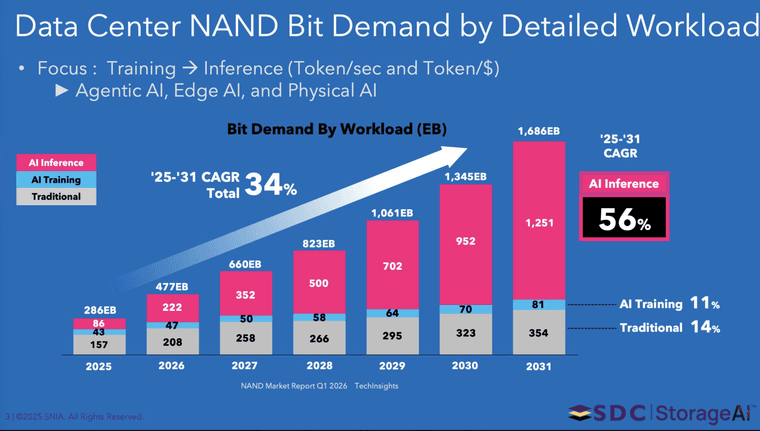
Interesting forecast-NB this not total memory, just NAND- not HBM(DRAM). At today's prices 1686EB would be north of 1 Trillion USD. So adding DRAM we arrive at a forecast of 1.6 $T. Looks like early innings

-
We are rebalancing today, a timely opportunity to trim the surplus weight from Micron having touched $650 earlier
We purchased the holding in Feb 25 for $89.82
NB we are trimming it NOT selling is.
-
Thanks for the heads up, are you buying into any other tech stocks. Thanks
-
Hi Jason,
Tweaks at the last rebalance(yesterday). It's more a case at the moment of looking at some holdings, Meta for example and determining that given its growth the market is discounting it unjustly. If you look at what is happening lately money is flowing into some areas, leaving others out of favour which is fine if that is based on fundamentals however in MSFT/Meta's case I would take the view that growth is up, EPS is up but the stock is down. All we have to do is(if correct) add more weight to these and reduce a bit elsewhere.
I'm always looking at new ideas but it takes time to get comfortable with the business. Often the best opportunity is the one you currently hold- you get to know them very well and sometimes you think 'opportunity'. Stocks are almost always mispriced-some too high, some too low. Look at Micron, from 450 to 319(30 march) and today it's $650. That is an unusual situation however the principles are solid. If the evidence says hold, you do so. Never let a score board (tail) wag the dog(investor). We have been talking about its ridiculously cheap price for 6-9 months- we didn't get lucky. We did the work and it paid off handsomely. Patience is key.
If anyone wants to discuss they are welcome to contact me.
Regards
Adam
