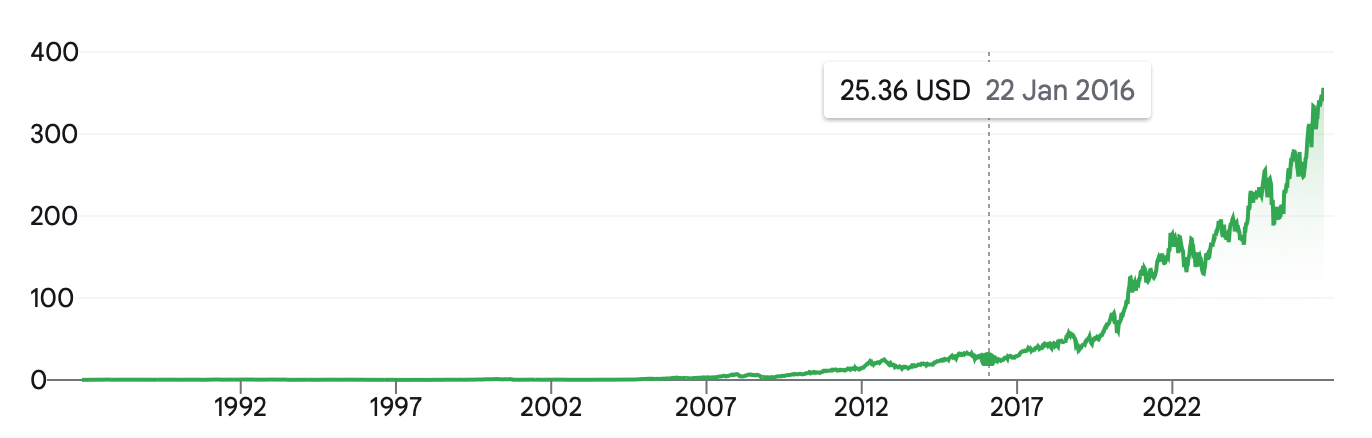
Tough times
-
Been a shocking few weeks across the board. Hope the windows are nailed shut at Cobens Towers.
On a serious note many current PE ratios are ridiculous and the foward ones even more so. Old Jensen has really upset the applecart. If nvidia can demonstrate resilience hopefully they, and we, can recover from this over the next 12 months.
Keep the faith. -
I'm still up a little over the last six months and much more so over a longer period. However it has indeed been a rough few weeks.
I fairly often quote Terry Smith; 'if you don't like the numbers on the screen, turn the screen off'. There's truth in that, but it does require some nerves at times like this.
-
Market Meltdown – Fear, Fundamentals and the Bigger Picture for AI
Well, what a bloody awful week!
There's no point pretending otherwise. Watching some of the world's finest businesses lose enormous amounts of market value in a matter of days is unpleasant, frustrating and, frankly, at times utterly bewildering.
It's been a proper rout.
But I think it's important to distinguish between what is happening to share prices and what is happening to the underlying businesses. They are not the same thing, and right now I believe there is a considerable disconnect.
So what's actually caused this?
In my view, we're witnessing a combination of fear, uncertainty and a market that has suddenly become obsessed with finding reasons to sell anything associated with AI.
Jensen Huang's unexpected departure from Nvidia has undoubtedly contributed. He was arguably the most influential individual in the AI infrastructure industry, and the uncertainty surrounding Nvidia's leadership has understandably unsettled investors.
Then came reports of an SEC investigation into Nvidia's accounting. An investigation is not evidence of wrongdoing, but it's hardly helpful when investors are already nervous. In fact the SEC always investigate these situations. I do not believe Nvidia, who are severely constrained have chosen to knowingly ship chips to China (illegally). Singapore is a hub for the Mag 7 for tax reasons-they have said so before.
Add concerns about interest rates, AI valuations(some not all), the enormous capital expenditure commitments being made by the hyperscalers and whether all that spending will ultimately generate satisfactory returns.
These are legitimate questions. Investors should be asking them.
But I think the market has gone from questioning the sustainability of AI investment to behaving as though the entire AI opportunity is coming to an end. It isn't. There is no evidence that the build is slowing or planned to slow. Just a tonne of what-if speculation and fear mongering.
There's also the mechanics of a sell-off. Momentum trading, leveraged positions, institutional de-risking, profit-taking and investors rushing for the exits.
Selling creates more selling. Fear feeds on itself.
And once that happens, fundamentals can become almost irrelevant in the short term. Remember that. But fundamentals always matter, if not this week or next they will.
Let's look at the businesses we actually own
We hold Nvidia, Micron, Broadcom, Microsoft, Alphabet and Meta et al.
These are not speculative start-ups trading on 200 times earnings with little revenue, no profits and business models that might eventually work.
They are established global businesses with enormous revenues, substantial earnings, formidable competitive positions and genuine demand for their products and services.
Nvidia: The company has recently delivered another exceptional set of results. Demand for accelerated computing remains enormous. Its technology leadership, software ecosystem and customer relationships haven't suddenly disappeared because the share price has fallen. Jensen's departure introduces uncertainty, absolutely, but it doesn't make Nvidia's technology obsolete.
Micron: Demand for memory, particularly high-bandwidth memory used in AI accelerators, remains exceptionally strong. Supply is constrained, pricing has strengthened and customers are increasingly seeking long-term supply agreements. Memory has always been cyclical, but the structural demand picture is compelling. A sharp fall in the share price doesn't suddenly create an oversupply of HBM. Sanjay, as recently as Wednesday said demand has never been so strong and customers actually want to sign up for supply (5 years) which they actually must decline to sign because they won't be able to meet the demand. Who are you going to listen too! Apple last week committed to a 5 year memory deal-are we to believe that a company with the most sophisticated supply chain management understanding in the world doesn't know memory needs locking up years ahead or is stupid, didn't get the memo.
Broadcom: A major beneficiary of custom AI accelerators and the networking infrastructure required to connect increasingly powerful computing systems. The growth of custom silicon provides another avenue for AI investment, rather than simply replacing demand for existing accelerators.
Microsoft: Azure, enterprise software, cloud infrastructure and an enormous installed customer base. This is already a hugely profitable business, with AI providing another potentially substantial growth engine.
Alphabet: Search, YouTube, Google Cloud, its own AI models and proprietary computing infrastructure. It has multiple opportunities to benefit from AI, both by developing the technology and deploying it throughout its existing businesses.
Meta: Billions of users, an extraordinarily profitable advertising business and considerable opportunities to improve advertising effectiveness, recommendations and engagement through AI.
Now, are these businesses immune to competition, disappointing earnings, management mistakes or valuation corrections?
Of course not.
But where is the evidence that their underlying businesses have collectively deteriorated by anything approaching the magnitude suggested by the recent share-price falls?
I don't see it.
That is the distinction I think investors need to keep firmly in mind.
This isn't the dot-com bubble
I'm getting rather tired of the comparisons with 1999 and 2000.
Yes, there are similarities in the enthusiasm surrounding a transformative technology. Yes, some valuations have become stretched. And yes, some AI investments will undoubtedly prove uneconomic.
But there is an enormous difference between the speculative internet companies of 2000 and the businesses we're discussing today.
Back then, investors were frequently paying extraordinary valuations for companies with little revenue, no earnings and business models that had barely been tested.
Today, many of the principal beneficiaries of AI are already generating tens or hundreds of billions of dollars in annual revenue and substantial operating profits.
The technology is being deployed commercially, customers are spending real money and the infrastructure is being built to meet genuine demand.
That doesn't mean share prices cannot fall 30%, 40% or even 50%. They can, and history demonstrates that they sometimes do.
Nor does it mean every company is attractively valued at every price. And this is why I regularly point out the disparity between our holdings and others like Croudstrike which makes no money despite being a 30 year old company
**But confusing a valuation correction with the collapse of an entire industry is a mistake.
A falling share price does not automatically mean the investment thesis is broken.** It's unpleasant for sure.
What would Warren Buffett make of all this?
Buffett has spent decades explaining that markets are driven by human emotions as much as business fundamentals.
His famous observation that the market is a voting machine in the short term but a weighing machine in the long term is particularly relevant.
In the short term, prices reflect sentiment, fear, greed, positioning and expectations.
Over the long term, what matters is the ability of a business to generate earnings and cash for its shareholders.
And history is littered with examples of outstanding businesses suffering enormous drawdowns before recovering and establishing new highs.
Nvidia itself has experienced several declines exceeding 50% during its history, only to recover and go on to establish new records.
We've seen similar episodes with Microsoft, Amazon, Alphabet and numerous other exceptional businesses.
Quality businesses with strong earnings, competitive advantages and genuine long-term growth prospects have repeatedly demonstrated their ability to recover from even the most savage market corrections.
And when confidence returns, those recoveries can be remarkably swift.
The companies that often don't recover are those whose business models were fundamentally flawed, whose valuations depended on unrealistic assumptions or whose competitive positions have permanently deteriorated.
That's precisely why we focus on owning quality businesses rather than chasing speculative opportunities.
Markets can punish good companies alongside bad ones during a sell-off. But over time, their underlying business performance is what separates them.
Buffett has also repeatedly emphasised the importance of temperament.
Successful investing isn't simply about understanding balance sheets, earnings forecasts and valuations. It's about maintaining the emotional discipline to make rational decisions when everyone around you is panicking.
And that is considerably easier said than done!
The reality is that you cannot reasonably expect to participate in the long-term growth of outstanding businesses without occasionally enduring some thoroughly unpleasant periods.
That's the price of admission.

Markets can be extraordinarily irrational
One of the great misconceptions about financial markets is that share prices always accurately reflect the value of a business.
They don't. And Ive even said it before 'this ones getting frothy'
When confidence is high, investors extrapolate good news too far into the future.
When confidence collapses, they can do precisely the opposite.
A company can deliver outstanding results, raise guidance and still see its shares hammered because investors have suddenly decided they don't want exposure to the sector. They listen to some guru or read a tweet
Sometimes markets anticipate genuine problems. We should never dismiss that possibility.
But sometimes the market is simply frightened.
And when fear takes hold, investors frequently sell what they can rather than what they should. Shoot first , throw the baby out with the bathwater behaviour.
This is why I believe it is so important to concentrate on the underlying businesses rather than the daily fluctuations in their share prices.
Are revenues and earnings growing?
Are competitive positions intact?
Is demand for their products continuing to expand?
Are they generating cash?
Are valuations reasonable relative to their future earnings potential?
Those are the questions that matter.
If the answers change, we reassess. That's responsible portfolio management.
But abandoning a long-term investment strategy simply because the market has become frightened is something entirely different.
And while the market is panicking, look what's happening in AI itself
Here's something else that happened this week, and I think it could prove considerably more important than the latest market sell-off.
**AI may have helped solve one of the greatest unsolved problems in mathematics.
It's called the Riemann Hypothesis.**
For those unfamiliar with it, the problem was first proposed by German mathematician Bernhard Riemann in 1859.
It concerns prime numbers, the fundamental building blocks of mathematics.
Prime numbers are numbers such as 2, 3, 5, 7 and 11 that can only be divided by themselves and 1.
Although primes follow precise mathematical rules, their distribution among the natural numbers appears remarkably irregular.
Riemann discovered a profound connection between the distribution of prime numbers and a mathematical function known as the Riemann zeta function.
His hypothesis makes an extraordinarily precise prediction about where certain zeros of that function must lie.
That might sound rather obscure, but proving it would establish something fundamental about the mathematical structure governing the distribution of prime numbers.
And here's the extraordinary part.
For 167 years, some of the greatest mathematicians in history have tried and failed to prove it.
Computers have checked enormous numbers of examples, and the results have consistently supported the hypothesis.
But checking trillions of examples isn't enough. Mathematics requires a proof that something is true in every case, including infinitely many cases that no computer could ever examine individually.
That's why the problem is so difficult.
You cannot simply throw more conventional computing power at it and check every possibility. You need a genuinely new mathematical argument.
It is so notoriously difficult that the Clay Mathematics Institute designated it one of the seven Millennium Prize Problems, with a $1 million prize for a valid solution.
And now, a mathematician working with an AI model has announced what he believes is a proof.
The claim is supported by an enormous archive of mathematical code written using Lean, a system designed to formally verify mathematical arguments.
There are reports that independent mathematicians have successfully compiled and checked the formal proof.
Why is that important for AI?
Because mathematics is a particularly unforgiving test of intelligence. There is no room for a plausible-sounding answer. A proof must be logically watertight. If AI can genuinely solve a problem that has defeated generations of brilliant mathematicians, it demonstrates something considerably more significant than generating text, pictures or computer code.
But let's be clear: the Riemann Hypothesis has not yet been conclusively established as solved.
The crucial remaining question is whether the verified mathematical argument genuinely proves the original hypothesis. That still requires independent scrutiny.
Nevertheless, this is a serious claim, not simply a chatbot announcing that it has solved an impossible problem.
And if the proof stands up?
Well, just think about the implications.
This could change how scientific discoveries are made
We're potentially witnessing AI move beyond processing existing human knowledge into making genuinely original discoveries that have eluded the finest human minds for generations.
That is an extraordinary prospect and why I believe so much money is being poured into it-the leading executives/investors know it has very serious potential to change humanity. I genuinely believe that. Believe what you will and vested interest yes maybe. Anthropic(ANT) believes all major serious cancers solved in 10 years.
Think about medicine, drug discovery, physics, chemistry, materials science, engineering and semiconductor design.
Problems that might previously have occupied brilliant researchers for decades could potentially be tackled much more quickly by increasingly capable AI systems.
Imagine thousands or millions of autonomous research agents working continuously, testing hypotheses, exploring different approaches and collaborating with human scientists.
We're no longer simply talking about chatbots, writing emails, generating pictures or improving office productivity.
We're talking about the possibility of fundamentally accelerating scientific discovery itself.
And remember, this technology is still relatively young.
What might these systems be capable of in five years? Ten years?
Nobody knows.
But I think we should be extremely careful about underestimating the possibilities.
And this isn't about Anthropic winning the AI race simply because its model was involved in this particular claim.
I don't believe AI is necessarily a winner-takes-all market.
OpenAI, Google, Anthropic, xAI and others are all developing increasingly sophisticated systems. Different developers will have different strengths, and advances across the industry should continue to push the boundaries of what AI can achieve.
The bigger story is the advancement of machine intelligence itself, not which company happens to announce the latest breakthrough.
And what does all this mean for the AI investment thesis?
For me, it reinforces the long-term argument for building the infrastructure.
If AI increasingly becomes capable of undertaking genuine scientific research, the potential demand for computing resources could be extraordinary.
More sophisticated reasoning, more autonomous agents, more complex simulations, more data processing, larger models and increasingly demanding workloads.
All of this has the potential to drive substantial demand for accelerated computing, high-bandwidth memory, networking, storage and electricity.
Of course, technological progress doesn't guarantee that every pound invested in AI infrastructure will generate an attractive return.
Efficiency improvements could reduce the computing resources needed for individual tasks, competition will intensify and some investments will inevitably disappoint.
But if AI becomes substantially more useful and capable, the number and complexity of economically worthwhile applications could expand enormously.
And that's the point.
While investors are obsessing over whether AI infrastructure spending has peaked, we're potentially witnessing evidence that the technology is only beginning to demonstrate what it can achieve.
The next generation of AI systems could be capable of things we currently struggle to imagine.
And those capabilities could create entirely new markets and sources of demand that barely exist today.
This is why I think the long-term opportunity remains so compelling.
A final thought
I've been involved in financial markets long enough(almost 35 years) to have witnessed plenty of periods when investors became convinced that something had fundamentally changed and the outlook was suddenly dreadful.
Sometimes those concerns were justified.
But often markets had simply become excessively pessimistic.
Nobody can tell you where the bottom is, whether next week will be better or whether this correction has further to run.
I certainly can't, and I wouldn't trust anyone who claims otherwise.
What I can say is that my confidence in the long-term prospects of the businesses we hold remains grounded in their earnings, competitive positions, cash generation and the opportunities ahead.
We will continue to monitor those fundamentals carefully and reassess our assumptions when the evidence warrants it. And don't forget the journey we have had since 2022.
But I see no reason to conclude that a dreadful week in the stock market has somehow brought the AI revolution to an end. If only Jensen could see the potential impact he may have kept is strides on

The share prices have changed dramatically. The long-term opportunity hasn't necessarily changed with them.
Markets have experienced periods like this many times before, and outstanding businesses have repeatedly demonstrated their ability to recover and prosper.
That doesn't happen automatically, and it doesn't happen on a timetable of our choosing.
But I would much rather judge our investments by the progress of the underlying businesses over the coming years than by the collective mood of frightened investors over a few trading sessions.
The market can change its mind overnight. The long-term economics of a great business generally don't.
So keep some perspective, everyone.
This is unpleasant, absolutely. But volatility is part of investing, and periods of fear have always been part of financial markets.
Meanwhile, AI researchers may be on the verge of demonstrating capabilities that could fundamentally change the pace of human discovery.
That's the bigger picture I think investors should keep firmly in mind.
And as for the long-term AI infrastructure buildout?
Build, baby, build!
-
Thank you Adam
I really appreciate your insight and knowledge
Do you object if I shared your comments with friends of mine who like most of us are struggling to understand what’s been happening these last few days -
perfectly fine to share it-I would ask that nobody post it on any other public forums, please
-
Good info/opinion, Adam. Thanks!
-
Thank you Adam.
An excellent essay - informative, enjoyable and heartening to read. While the rest of us have spent Saturday morning shopping, washing the car, playing golf or GTA VI, etc, you've been beavering away on the keyboard and I for one really appreciate your work.
The only downside to your wise words, it seems to me, is that if AI does quickly develop technologies that exceed human comprehension, a downturn in the stock markets might be the least of our worries!
-
I don't buy into the whole Skyney/Space Odyssey narrative.
Btw-buybacks. Micron it's a very powerful tool and a very unique situation. A few companies in history have done so at this scale. 'extreme cash generation and unloved stock'
Im not saying this will happen but the maths is sound and based on consensus cashflow-which imo is way too low. By retiring stock the PE doesnt have to change at all. So one can remain pessimistic and the stock appreciates because the numerator(shares) falls dramatically. The facts are IF the business performs as expected-they will have 75B(now) +38B(+5 add QoQ) for the next 8 quarters and I say 8 because we cant reliably predict what comes after that(but the evidence is a continuation based on TSMC/Appl/SK and all their customers behaviour). This equates $519B in buy backs on a company today as crazy as this sounds, with a Market cap of $672B.
Yes, the stock price will change but you get the idea. In this static example they theoretically retire 77% of the share count. 1.1219B shares reduced to 260M. PE stays at 3.8! . EPS 176.67 which is consensus and again, low because they have shown beats every single Q!.
OK at todays share count that's $199.46B net which is $176.67 per share.
At 260M shares the EPS jumps to $767! so if it's still valued at 3.8X which if Microns earnings are durable will turn out to be laughable. The stock price other things being equal is just under 3k per share.Buybacks can start Dec 9th
I hope this illustrates the power of buybacks at this extreme level.
Nvidia has authorised $227B in buy backs so has signalled the same intent.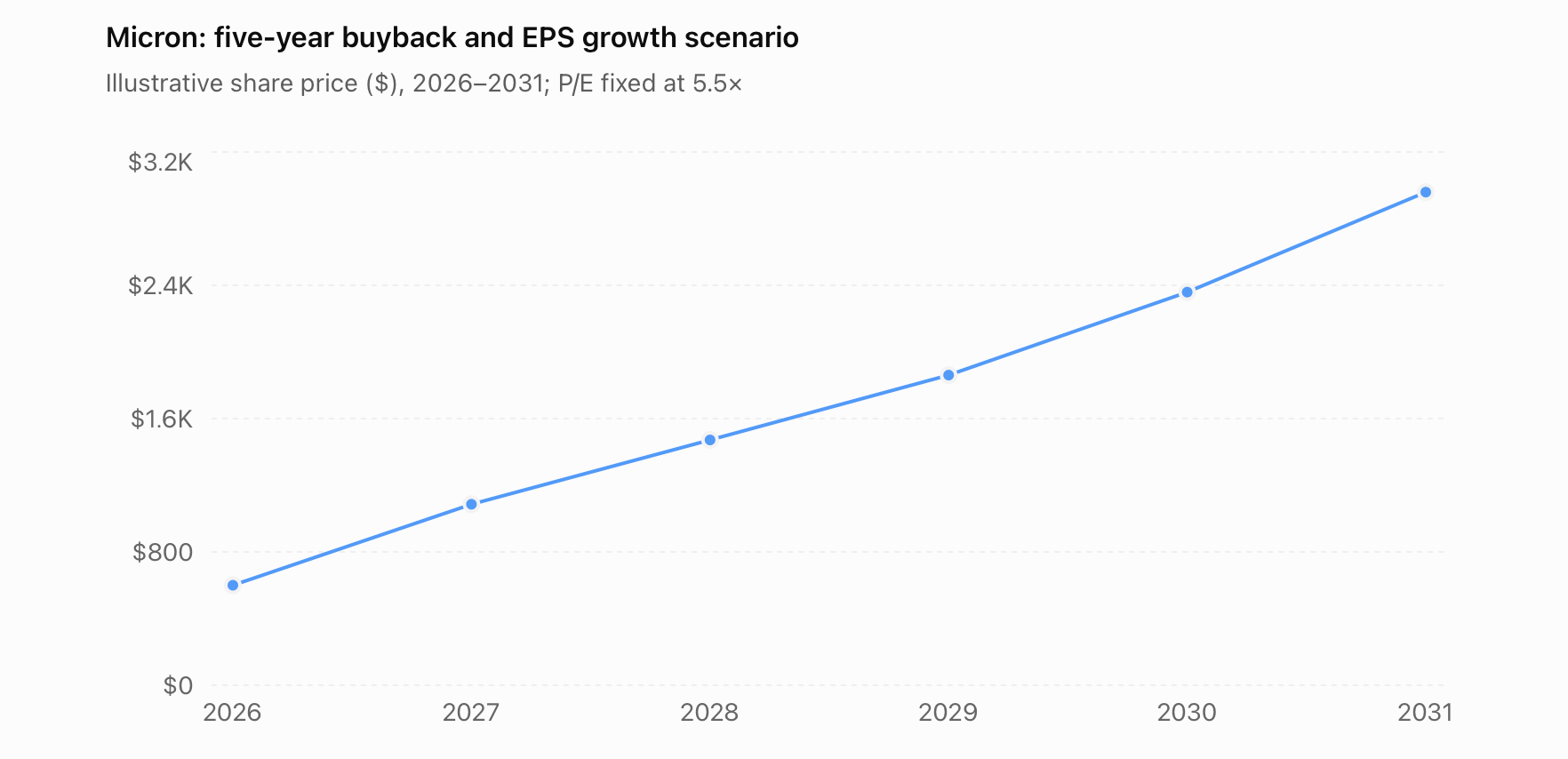
-
It seems that this point has been hidden in the mayhem of the last few weeks …and or completely ignored by the market
-
when you are panic selling (forced selling?)you let the stock price dictate the decision. Y have to understand too, that leverage is responsible as well(forced liquidation). Too many gamblers using 2-5X leverage so the impact is amplified and when stocks move more than expected it wipes out their equity and brokers force sell(margin calls not met). That is the big issue in Korea. They do like to gamble
Remember also, the upside in MU was hidden when it was $90 in feb 25.
We've discussed before how two analysts can look at the same data and come to completely different conclusions and that can be intentional to suit a narrative. Money involved, you know there will be some less than honest pundits.
-
Apple 10 year buy backs
Micron has the cash to spend even more(well over 75B/y-maybe 2X and not at a PE of 25-20(2.5-3)
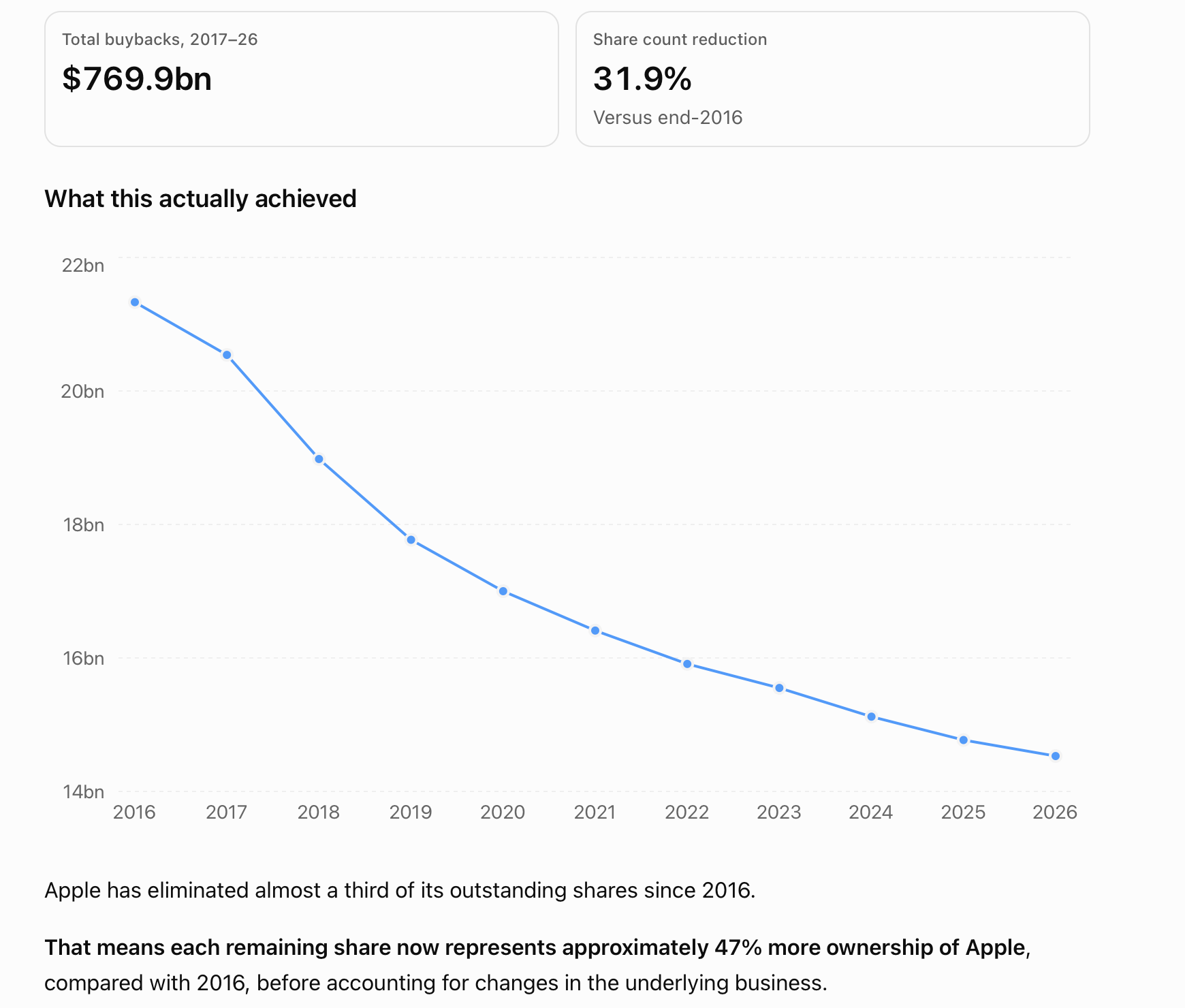
from start to date-interesting