
Micron Technology
-
Micron ($MU) – Sanjay's drop-the-mic moments at the TomorrowX Summit last week.
If anyone still thinks this is just another memory cycle, they really need to listen to what Sanjay is saying.
Some absolute bombshells:
2027 and 2028 will be even tighter than 2026. Not easing, getting tighter. Let that sink in.
75% of 2027 production already sold. And they're already negotiating supply agreements for 2028. Why not 100% you may wonder. Because prices are still rising so management hold back some capacity to negotiate even higher prices. Either way it's all sold out.
Customers want MORE than Micron is prepared to commit. Demand is so strong Micron is deliberately keeping capacity uncommitted. This customer request isn't for supply today it's over their 5 year SCA-they want Micron to agree to supply even more in 28 through 31. Micron will not guarantee it.
No visibility on when supply catches up with demand. So much for the inevitable collapse in 2027, then 2028, and now apparently 2029. Sanjay says we have no visibility as to when demand falls below supply-quite the statement. SK, Samsung say exactly the same thing.
26 strategic customer agreements, involving $32bn in upfront cash and commitments. Five-year deals, with pricing protections and take-or-pay provisions. This isn't the old memory market.
Memory is now mission-critical to AI. It's no longer simply about buying the cheapest DRAM. Performance, bandwidth, capacity and power efficiency are everything.
2027 expected to be stronger than record-breaking 2026. Sanjay sees no deterioration in demand.
Customers can't simply walk away from their contracts. Gavin Baker pushed Sanjay on what happens if AI demand drops 10–15%. Sanjay was clear about the strength of the contractual protections. Before anyone says demand will fall. In 2026 the data centre market added about 12GW of compute in North America. The existing commitment is +22GW in 2027 and more again in 2028. It's a done deal and it will be built. Why, because the hyperscalers have 2.48T in backlog(signed and sealed customer contracts)-they don't have enough compute. It's that simple.
Next-generation 3D DRAM is coming. Another potentially enormous opportunity from 2028 onwards. Micron’s 3D DRAM could be an absolute game changer. By stacking memory cells vertically rather than shrinking them horizontally, Micron could dramatically increase bit output per wafer while reducing costs per bit. Recall that the silicon is the expensive part-think sky scraper on a small piece of land!
Buyback restrictions expire 9 December. Micron can start deploying excess cash into shareholder returns. At these earnings multiples, the potential EPS leverage is staggering. This is the big one to watch. How much cash. Today they hold about $70B in surplus cash, growing at around 37B(+$5B) per quarter-not annually and all of it is being used to retire shares. The impact is going to be fundamental and almost unprecedented at this scale. Something like 2X Apple's massive buy backs over the last decade and starting from a MCap half that of Apple. Ergo 4X more leverage
-
keeping up to date (report today that Nvidia GPU are 26 weeks lead(demand so great)
The memory manufacturers are prioritising server DRAM to such an extent that Nvidia is reportedly having to cut gaming GPU production because of insufficient GDDR7 availability.
That implies:
- HBM supply is tight.
- Server DDR5 supply is tight.
- GDDR7 supply is tight.
- Consumer DRAM supply is being squeezed.
- Pricing power is spreading across the memory market.
Micron doesn't necessarily need to sell more bits to make more money. It can benefit from higher ASPs across its existing production.
This is precisely the structural shortage thesis we've been discussing. AI isn't simply consuming additional memory production — it's displacing existing demand across other industries.
-
It's nothing but speculation. Bears 'screaming fire in a crowded theatre'
I don't blindly form an opinion and hold fast to it. I'd challenge anyone to put forward a counter argument. EG. Yesterday a doom and gloom merchant stated that demand will fall and cited Mid Term elections as proof. What proof? Speculation that Dems are anti data centre. It's speculation based on some other inserted opinion dressed up as fact. It has no credibility whatsoever.
It's the same nonsense as citing the railroads or Cisco in the 2000s
We have discussed this. Share prices often don't = value.
-
Here is an example of peddling misinformation
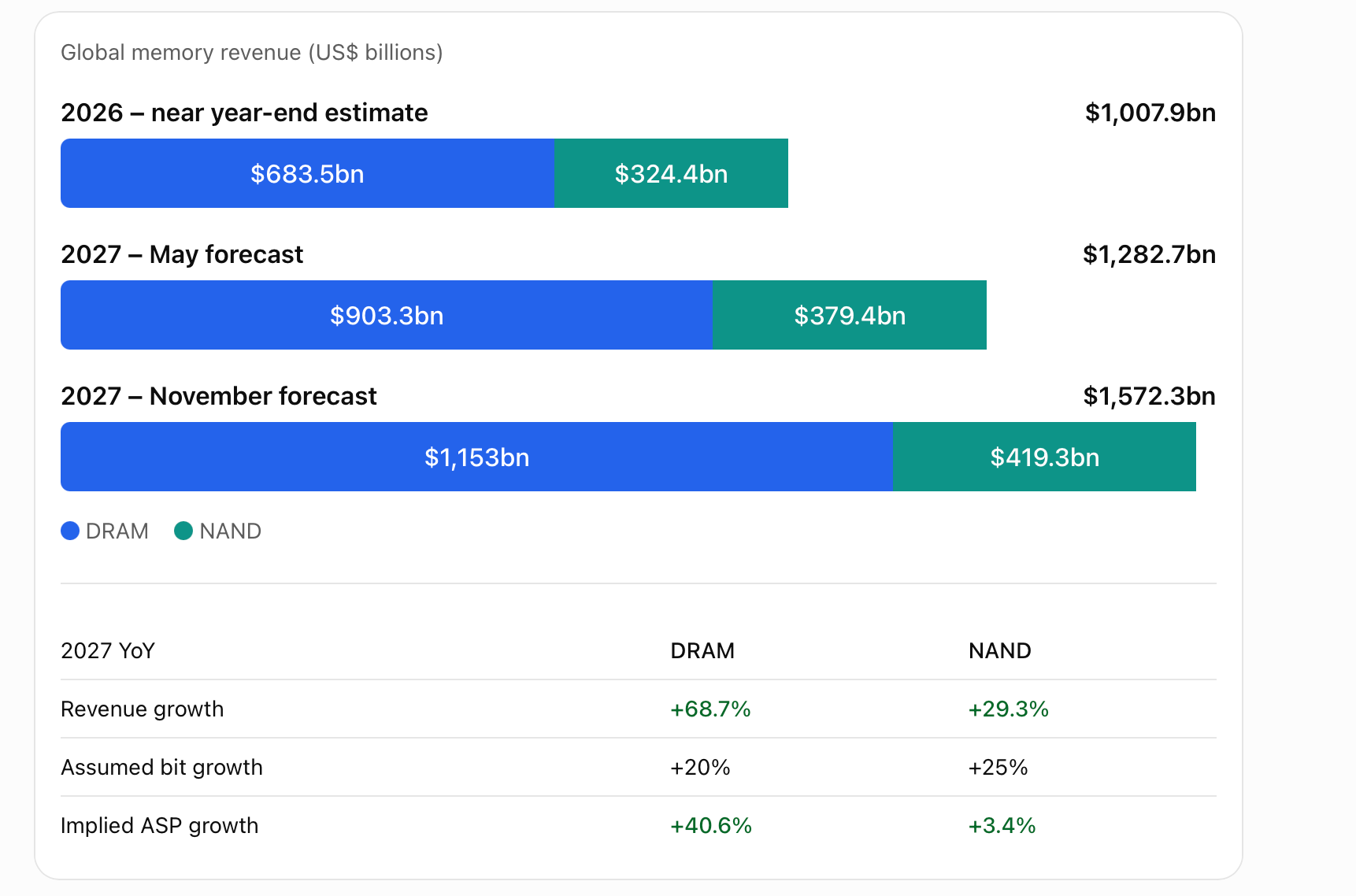
TrendForce's memory downgrade – or another dose of FUD?
Much has been made of TrendForce's supposed downgrade to its 2027 memory market forecasts. However, when you actually unpick the published reports, a rather different picture emerges.
May 2027 forecasts:
DRAM: $903.3bn
NAND: $379.4bn
November 2027 forecasts:
DRAM: $1,153bn
NAND: $419.3bn
That's a 27.6% upgrade to DRAM and a 10.5% upgrade to NAND, representing nearly $290bn in additional industry revenue compared with May's published forecasts.
Furthermore, TrendForce now expects DRAM revenues to grow by approximately 69% in 2027, compared with its previous published expectation of 46%.
TrendForce describes its latest revision as a downgrade against an intervening forecast, but hasn't publicly quantified that previous forecast. Crucially, its underlying research explicitly states that the overall DRAM demand outlook remains unchanged.
With assumed bit growth of 20%, the latest revenue forecast implies annual blended DRAM ASP growth of approximately 41% in 2027.
Yet some would have you believe that memory demand is deteriorating and pricing is about to collapse.
There is a world of difference between moderating price increases and falling prices, just as there is between slower growth and declining demand.
By all means discuss the risks, but at least present the numbers and the context.
Surprise, surprise – some appear more interested in peddling a bearish narrative than examining the underlying data.
The only quantifiable revision between the publicly disclosed forecasts we have identified is a substantial UPGRADE.
-
Micron – business update, 24–27 November
Putting the share price noise aside, the latest operational developments remain extremely encouraging:
Micron has confirmed 26 binding, multiyear take-or-pay customer agreements extending through 2030.
More than 75% of projected 2027 production is already committed. Retaining uncommitted capacity provides Micron with the flexibility to capture further price increases rather than locking in its entire production prematurely.
Negotiations for 2028 supply agreements are already underway, with management expecting supply conditions to become even tighter.
Customer financial commitments have reached $32bn, predominantly in cash deposits, underpinning approximately $150bn in remaining contractual performance obligations.
HBM4 production has successfully ramped, with global manufacturing expansion remaining on schedule.
Goldman Sachs estimates conventional DRAM prices would need to fall 32–54% below its forecasts before customers had a meaningful financial incentive to default. And I would speculate using basic economic theory, why would price fall at all if supply is structurally deficient. In actual fact ASP is expected to increase further.
The WSJ reports unprecedented memory shortages, with manufacturers demanding advance payments and supply constraints potentially persisting through 2030.
Micron's latest proxy filing references its capacity to increase capital returns(buy backs), having ended FY2026 with $73.5bn in cash and investments.
Customer cash deposits provide an additional source of liquidity, potentially supporting accelerated share buybacks, subject to contractual restrictions and future repayment obligations.
Despite the relentless speculation about an impending collapse in memory pricing, the evidence continues to point in the opposite direction: tightening supply, rising customer commitments, stronger pricing power and extraordinary cash generation.
December's earnings announcement should make for particularly interesting reading, not least regarding the potential scale of share buybacks.
-
Micron and the principle of falsifiability
I consider this to be one of the fundamental flaws in the current memory bear thesis. And it's super interesting.It brings to mind Karl Popper's philosophical concept of falsifiability — the principle that a hypothesis must be capable of being disproved through observation or evidence. It directly applies to the MU situation because the bear case has no evidence.
The classic analogy is the existence of God. The inability to disprove God's existence does not constitute evidence that God exists.
Similarly, predicting that memory earnings will eventually collapse, without specifying a timeframe, magnitude or identifiable catalyst, is effectively an unfalsifiable proposition.
For the past two years, we have repeatedly been told that the memory cycle is approaching its peak. Yet earnings continue to exceed expectations, guidance continues to rise, supply constraints persist and customers are increasingly securing capacity years in advance.
Rather than reconsidering the thesis, the bears simply move the goalposts-'prices will fall at some point' how insightful.
What happens if Micron continues to beat expectations throughout 2027? What if earnings continue growing throughout 2028 and 2029? At what point is the original thesis considered wrong?
Nobody is suggesting that memory earnings will grow indefinitely. The pertinent questions are when earnings will peak, at what level, and whether the subsequent adjustment will be a collapse, a modest decline or simply a period of stabilisation.
Calling the peak in a share price is not the same as calling the peak in a company's earnings.
Equally, the bullish thesis must be subject to the same intellectual discipline. Evidence of sustained oversupply, weakening demand, deteriorating contract pricing or falling margins would warrant a reassessment.
But assigning an earnings collapse as an inevitability, without defining when it will happen or what evidence would invalidate that prediction, is not particularly useful investment analysis.
If no amount of contradictory evidence can persuade you to reconsider your thesis, it has ceased to be analysis and become a belief system (faith).
-
Adam….it seems that for the last few weeks that all the naysayers have been shouting the loudest ….and getting heard.
Let’s hope that come earnings and share buybacks days they are made to eat humble pie and crawl back under their rock -
An example of blatant misrepresentation when the facts say the opposite
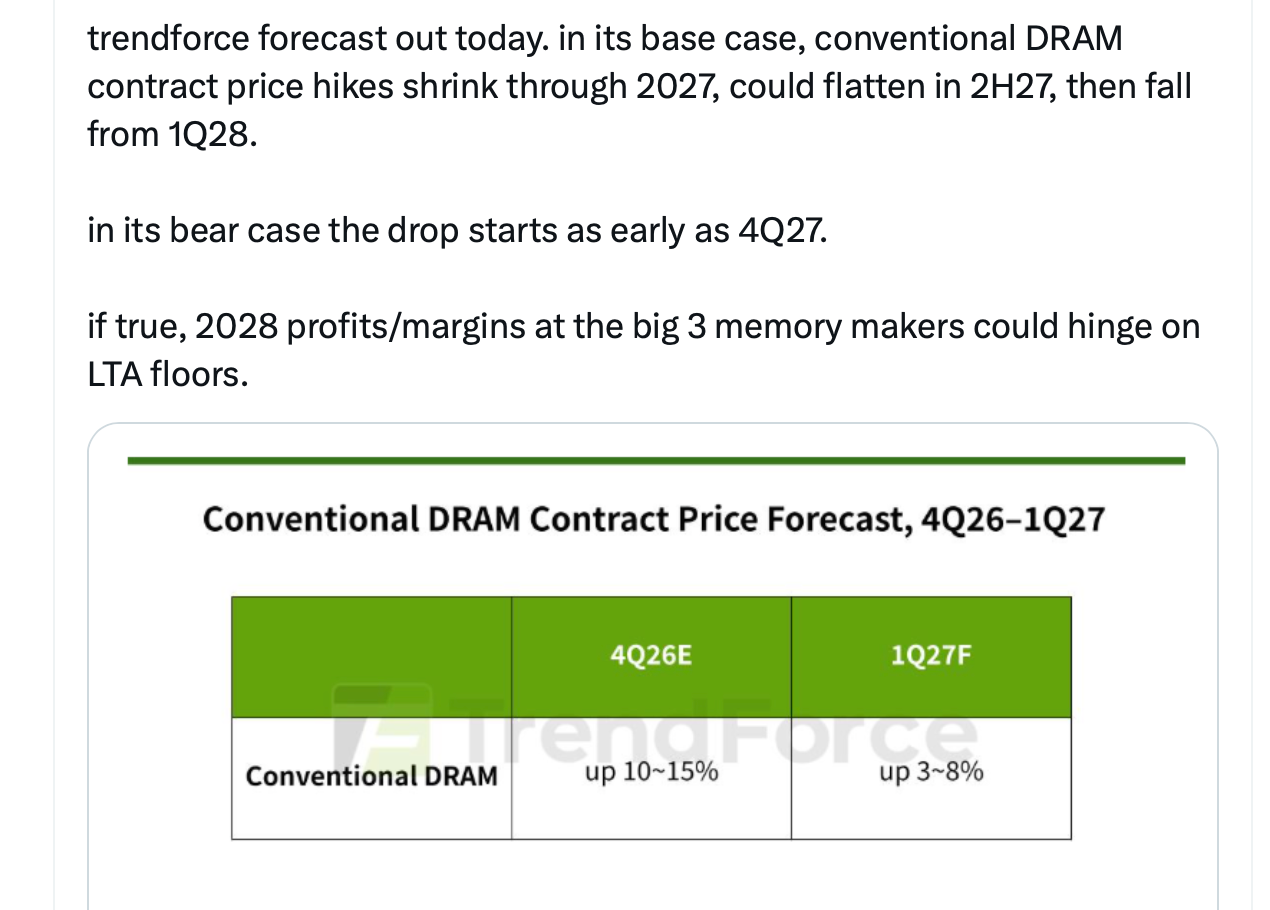
First-there is no opinion on 2028 yet
Second- LTA floors were negotiated quarters ago. Prices today are well above that so how would 2028 prices 'hinge on LTA floors'Samsung has explicitly contradicted the idea(last night) that additional capacity will resolve the memory shortage in 2028.
"On balance, with all things considered, we expect tight supply conditions to continue in 2028."
Samsung explained why:
- Increased 2027 capex is unlikely to meaningfully increase bit production in 2028.
- Equipment delivery lead times are increasing.
- HBM4E and HBM5 require larger dies and more complex manufacturing processes.
- Physical supply constraints arising from the shift towards HBM are unavoidable.
- Customer requests for additional contracted volumes have substantially exceeded expectations.
There was also a report yesterday, 26 November, about Tesla struggling to secure long-term memory supplies from Samsung, despite offering factory financing guarantees. Samsung's chairman reportedly asked what additional incentives Tesla could offer because other customers were making similar proposals.
It's Chicken Little Friday 'in 13 months it's all over folks'