
Nvidia News
-
Did Nvidia suggest they alone would buy all the memory?
On today’s conference call, NVIDIA stated that it expects the standalone Vera CPU market to reach $20 billion in FY2027.
The unit price of Grace CPU is estimated at around $3,000–$5,000. Since Vera is the successor to Grace and is optimised for AI agentic workloads, we expect Vera to carry a higher ASP of roughly $5,000–$8,000 per unit.
Assuming a Vera CPU ASP of $8,000, a $20 billion market would imply 2.5 million CPUs.
It remains unclear whether standalone Vera CPU sales will include the same SoCAMM capacity as NVL72. However, assuming the same capacity is applied, each Vera CPU would have 8 SoCAMM slots. Assuming 192GB per module, SoCAMM capacity per Vera CPU would be 1,536GB.
Therefore, FY2027 SoCAMM demand for Vera CPU would be:
2.5 million CPUs × 1,536GB = 3.84 billion GB, or 30.72 billion Gb.
CY2026, which broadly overlaps with NVIDIA’s FY2027, SoCAMM supply from the three major DRAM makers is estimated at 30 billion Gb. Therefore, combined SoCAMM demand from NVIDIA’s standalone Vera CPU sales and VR NVL72 sales already appears likely to exceed the annual (global)supply capacity of 30 billion Gb.
Assuming CY2027 VR NVL72 shipments of 100,000 servers, we estimated the SoCAMM TAM at 44 billion Gb based on 192GB modules. If additional SoCAMM demand from standalone Vera CPU sales is added, the CY2027 SoCAMM TAM could exceed 80 billion Gb.
An annual 80 billion Gb of LPDDR5 would be nearly equivalent to the annual LPDDR5 TAM used for smartphones.
The shortage of LPDDR5 — and of DRAM overall — is likely to intensify further over time.
-
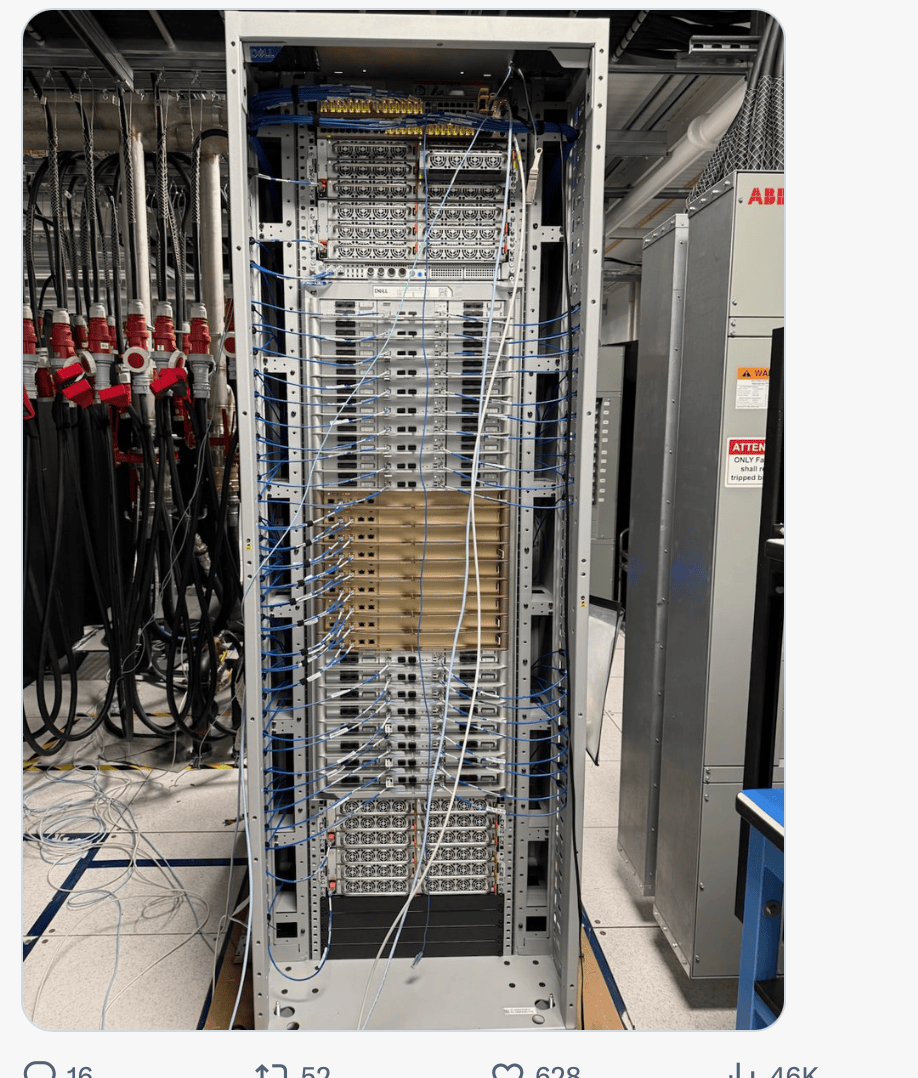
Beyond the precious. Price $7-$8M which includes circa $1.3M in 'memory'. It's early! Each rack requires 20.7 TB of HBM4. Micron is in 'mass production' phase-all sold out until 2028 at least

-
Uber, Autobrains, and NVIDIA are teaming up to launch a robotaxi pilot in Munich (pending approval).
Uber brings the ride-hailing platform, Autobrains provides the self-driving software, and NVIDIA supplies the DRIVE Hyperion hardware that supports Level 4 autonomous driving.
Level 4 basically means the car can handle all driving within a defined area without human input, but it still operates within limits like mapped regions or specific conditions. No driver needed in those zones, but it’s not fully “anywhere, anytime” autonomy yet.
The big idea here is scale: instead of one company building a closed system, they’re pushing an OEM-agnostic setup where different car manufacturers can plug into the same stack and join Uber’s network.
-
Headline-Cathie Wood loads up on Nvidia, cuts AMD across flagship ARK funds.
Cathie sold out of Nvidia before the run in 2023 and spent the next 2.5 years calling it over valued -she sold at between $14-$20 and now she 'loads up'.
-
Nokia (NOK) said it has developed the telecom industry's first commercial artificial intelligence-powered radio access network (AI-RAN) platform in collaboration with Nvidia (NVDA), a move aimed at significantly increasing the amount of data mobile operators can transmit over their existing network infrastructure.
The development comes less than 10 months after the two companies announced a strategic partnership, which also included Nvidia taking an equity stake in the Finnish telecom equipment maker.
Built on Nokia's AI-native anyRAN software and Nvidia's Aerial AI-RAN platform, the new system is expected to deliver more than a 100% improvement in spectral efficiency by 2028, effectively doubling the capacity of existing spectrum assets without requiring operators to acquire additional spectrum licences. The platform has already demonstrated more than 20% gains in spectral efficiency through AI-driven radio innovations, Nokia said in a statement on Wednesday.
Nokia's AI-RAN solutions will enter pilot deployments later this year before becoming commercially available in 2027, with a roadmap built around Nvidia's programmable silicon platforms.
"Telecommunications is entering the AI era — the radio access network is the next AI infrastructure," said Nvidia founder and CEO Jensen Huang. "Together with Nokia, we are bringing NVIDIA CUDA and AI into the baseband, transforming RAN into a planet-scale AI computer. This is a generational shift for operators — unlocking more capacity and efficiency from today's spectrum while creating the foundation for new AI services and the 6G era."
The announcement positions Nokia at the forefront of one of the telecom industry's biggest technological shifts. If the promised efficiency gains are achieved in commercial networks, operators could dramatically increase network capacity while reducing the need for costly infrastructure upgrades and additional spectrum purchases. -
Nvidia-backed $500b AI financing structure
The $500b is not a USD 500b Nvidia loan facility. It is a target for third-party capital mobilised through financing platforms involving Nvidia and major financial institutions.
Structure:
Institutional capital
↓
Apollo / Blackstone / KKR / BlackRock / Brookfield / Goldman Sachs
↓
AI infrastructure financing
↓
AI cloud providers / data-centre operators
↓
Purchase of Nvidia GPUs, networking and infrastructure
↓
AI customers generate compute revenue
↓
Customer payments service the financing
Nvidia’s role is primarily to enable and de-risk the financing, rather than fund the entire build-out itself. In some structures, Nvidia can provide residual-value support of up to around 25% of project value, helping protect financiers if the underlying equipment is worth less than expected.
The model therefore allows Nvidia to sell GPUs upfront while institutional capital finances the customers buying them.
The crucial point: $500b refers to capital that could be mobilised over time, not USD 500b of Nvidia debt or guarantees.Burry is crying foul

-
It's a school day!
Nvidia is moving its future AI data centres towards an 800V power architecture, and the reason is pretty simple: the amount of power these systems need is getting ridiculous.
Today's AI racks typically use much lower-voltage power distribution(sub 60V), but as Nvidia moves towards racks needing hundreds of kilowatts, and eventually around 1MW(that's super massive-1 rack using the power of 600 houses!), the amount of current required becomes enormous. At 800V, you can deliver the same amount of power using far less current.
That brings some pretty big benefits. You need less copper, thinner cables and smaller busbars, which saves space, weight and cost. More importantly, lower current means much lower electrical losses, because resistive losses rise with the square of the current. So there is less energy wasted as heat.The 800V approach should also allow Nvidia to simplify the power chain, with fewer stages of voltage conversion. That improves efficiency and reduces the amount of power infrastructure taking up valuable space in the rack, so they can stuff more GPUs inside

Ultimately, it's about making much more powerful AI systems practical. As racks move towards 500kW and eventually 1MW, the old architecture becomes increasingly difficult to manage. 800V gives Nvidia a much more scalable way of delivering all that power efficiently.
-
What do we think these boys will report on Wednesday?
-
Record numbers
Revenue hard to say really however several tail winds. Blackwell yet to peak/firing. Vera Ruben mass production.
Demand exceeds supply
China H200 albeit modest.I think they could report close to $95B. The Guide will be at least +$10B over the reported Nr.
I think the QoQ rhythm is now in the range +$15B. If you go back we predicted $100B quarters by end of 26-early!Margins 75-76%. The transition to Ruben will always see a small initial margin compression due to yield. Corrects back end of the year.
Operating Margin 62%
Net income margin circa 55% (tax paid earnings margin)Nvidia has trailing growth rate of 80% and a realistic fwd of 45-50% over several years.